


In the mid-1950s, a prominent New York plastic surgeon began noticing a persistent anomaly among his patients. Individuals arrived at his clinic with profound distress over physical imperfections: a hooked nose, an irregular jawline, or a facial scar. Dr. Maxwell Maltz performed the operations with technical precision, successfully smoothing the tissue and removing the visible flaw. Yet when the bandages came off, a baffling split emerged. Some patients experienced immediate emotional relief. Others looked into the exact same mirror and insisted that nothing had changed. The scar was gone. The internal misery remained untouched.
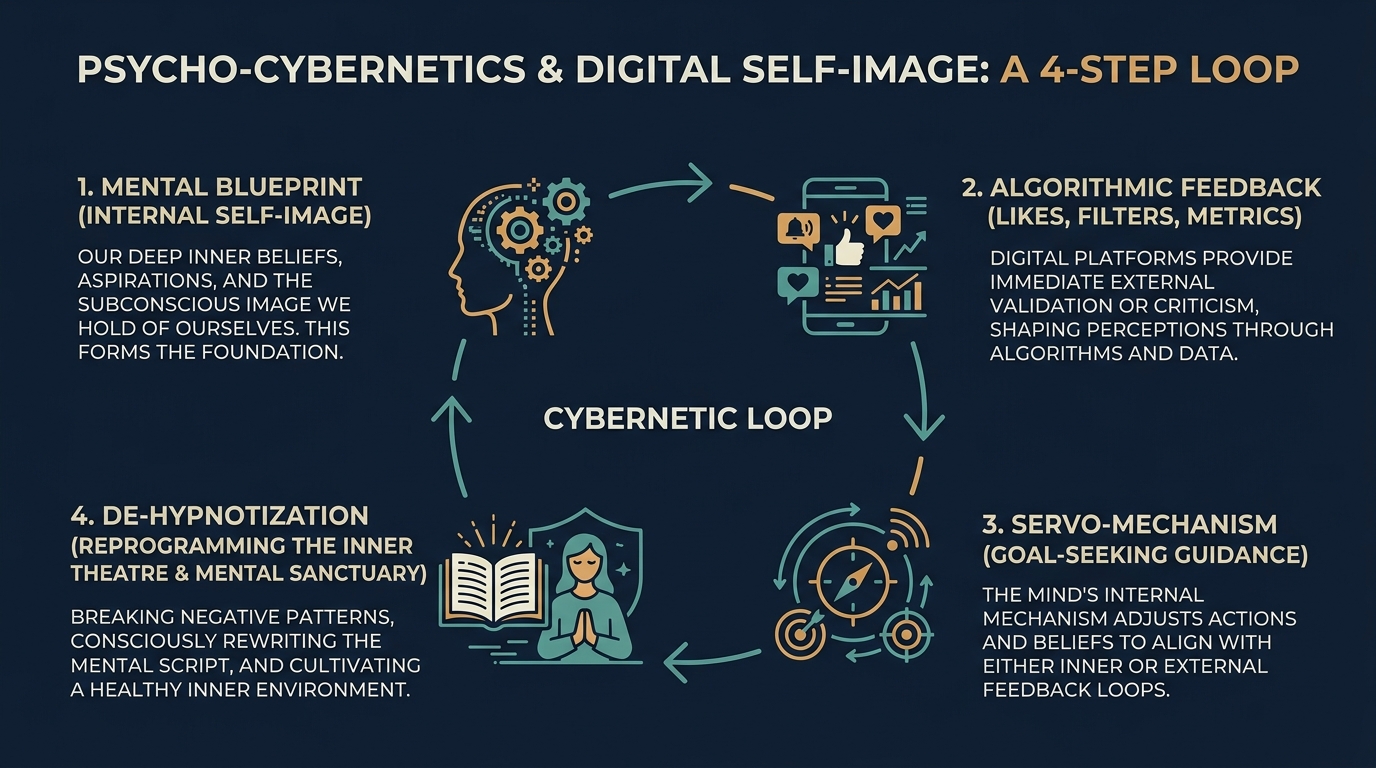
This clinical puzzle led Maltz to formulate the core thesis of Psycho-Cybernetics in 1960. He realized that people experience the world through an internal mental blueprint rather than physical skin alone. Exploring the principles of psycho-cybernetics digital self-image today reveals why modern smartphone filters, algorithmic metrics, and aesthetic curation trigger the exact same psychological trap on a massive scale.
The Surgeon Who Discovered the Mind’s Ghost Scars
Maltz’s discovery shifted his focus from cosmetic surgery toward clinical psychology. He recognized that altering physical anatomy is futile when the internal self-image remains wounded. Each person carries a subconscious portrait of their worth, capabilities, and appearance. When that portrait portrays an individual as inadequate, no amount of external modification can resolve the issue.
To understand this dynamic, Maltz turned to cybernetics—the emerging science of communication and control systems pioneered by Norbert Wiener at MIT. Cybernetics analyzed how mechanical guidance systems navigate toward a target using continuous feedback.
Maltz posited that the human brain and nervous system operate as an organic servo-mechanism. The subconscious mind does not debate moral philosophy. It simply pursues whatever goal or identity is programmed into its central registry.
“The self-image sets the boundaries of individual accomplishment. It defines what you can and cannot do. Expand the self-image, and you expand the territory of the possible.”
— Dr. Maxwell Maltz
Imaginary Ugliness in an Era of Algorithmic Curation
When Maltz analyzed his dissatisfied patients, he identified a condition he termed imaginary ugliness. The perceived deformity did not reside in the bone structure. It existed entirely as an unexamined premise within the patient’s self-concept.
The Error of Fixing the Skin When the Blueprint Is Distorted
In modern digital environments, this dynamic has transformed into a daily cultural ritual. Smartphone cameras and generative filters act as instantaneous cosmetic scalpels. Users alter skin texture, enlarge eyes, and reshape jawlines before broadcasting their likeness online.
Yet digital retouching creates the exact clinical dilemma Maltz documented seventy years ago. When someone receives compliments on an engineered persona, the subconscious mind registers a painful subtext. The praise belongs to the mask, not to the person behind it. The authentic self feels even more deficient by comparison. The physical self becomes an embarrassing rough draft of its digital avatar.
How the Servo-Mechanism Operates Without Moral Judgment
The human servo-mechanism functions as an automatic goal-seeking apparatus. When fed an objective, it measures the distance between the current state and the chosen setpoint. It then generates corrective adjustments through negative feedback.
The mechanism itself has no preference for joy over anxiety.
If a user installs the subconscious target “I must secure unconditional approval on Instagram,” the servo-mechanism accepts the premise as an absolute directive. Every unreciprocated message, slow-performing post, or unflattering photo is registered as an error signal. The system generates acute distress not because it is broken, but because it is faithfully attempting to correct course toward an impossible goal. The failure is not in the machinery. It lies in the programmed objective.
This algorithmic capture compounds the behavioral feedback loops we analyzed in our study on digital hedonism motivation.
De-Hypnotizing the Gaze: The Anatomy of the Passive Trance
Maltz observed that individuals suffering from poor self-esteem are effectively trapped in a state of self-hypnosis. They have accepted limiting, derogatory beliefs about themselves not through deliberate logic, but through uncritical repetition.
Screen immersion induces a comparable condition of passive hypnosis. Spending hours scrolling through curated highlights and hyper-optimized lifestyles gradually convinces viewers that their ordinary life is fundamentally inadequate. No one actively chooses to adopt this standard. The premise settles into the nervous system through constant sensory exposure, a vulnerability closely tied to patterns of digital perception and learning.
To dismantle this spell, Maltz developed the technique of creative imagination using the “Theatre of the Mind.” Experimental physiology indicates that the human nervous system struggles to distinguish between a vividly imagined synthetic experience and an actual physical event. Neural pathways fire in near-identical sequences during both deliberate visualization and real-world execution.
By dedicating quiet intervals to rehearsing competence and internal stability, an individual records new memory engrams. Reprogramming the internal blueprint dissolves the hypnotic hold of external scoreboards.
A Systems Perspective: Closed Loops and External Setpoints
From a computer systems perspective, the intersection between cybernetics and social media architecture exposes a profound vulnerability. In classical control systems, stability depends entirely on where the feedback loop is closed and where the setpoint originates.
When an internal biological system regulates body temperature, the setpoint is internal and stable. However, when an individual outsources their setpoint of self-worth to external platforms, the feedback loop is hijacked by an external server. The platform’s optimization algorithm is designed to maximize engagement, session length, and ad impressions—not user equilibrium.
Because variable rewards keep the nervous system in perpetual vigilance, the platform continually shifts the target. The user remains in a state of unresolved discrepancy. This dynamic mirrors the systemic confinement explored in our discussion of golden cages digital freedom. As long as the error-correcting servo-mechanism relies on external likes as its primary telemetry, emotional equilibrium remains computationally impossible.
This chronic feedback loop also accelerates the cognitive fragmentation documented in research on attention and social media.
Reclaiming Your Attention from the Surgical Scalpel of the Feed
These psychological concepts are not clinical verdicts. They are prompts for honest self-reflection.
Have you ever edited an image before posting, only to experience an uncomfortable wave of vulnerability when looking in a bathroom mirror ten minutes later?
Do you notice a sudden dip in energy and mood after viewing someone else’s vacation highlights, even when your own day was calm and productive?
When a post receives fewer interactions than anticipated, does your mind treat that lack of engagement as statistical variance or as personal rejection?
These subtle reactions indicate that your internal navigation system is treating algorithmic metrics as vital survival data. Reclaiming your agency starts with noticing when the feed attempts to operate on your self-concept without your consent, a pressure particularly acute for anxious generation social media teens.
The Epistemological Limits of Cybernetic Analogies
Psycho-cybernetics provides a compelling operational metaphor, but scientific rigor requires acknowledging its theoretical boundaries.
Maltz wrote in 1960, drawing heavily on clinical observation, historical anecdotes, and early cybernetic literature rather than modern randomized controlled trials. Treating the human brain strictly as a mechanical computer oversimplifies the rich emotional, social, and developmental complexities of human cognition. Modern neuroscience confirms neural plasticity and mental rehearsal benefits, yet self-concept is deeply relational and contextual rather than purely computational.
Furthermore, individual psychological reprogramming cannot completely compensate for predatory platform architectures that deliberately engineer social comparison, an issue that also surfaces when analyzing the displacement hypothesis social media. Individual discipline must be paired with structural awareness.
Building the Unshakable Inner Sanctuary
Maltz concluded his foundational work with a practical safeguard: the mental sanctuary. He urged his patients to construct an inviolable inner room within their imagination—a quiet space of non-reaction where external pressures cannot intrude.
In modern hyper-connected life, this sanctuary translates into a critical digital capability: non-reactive awareness.
The device vibrates; your attention chooses whether to respond.
When you refuse to allow algorithmic metrics to define your worth, the feed loses its coercive power. Technology returns to its proper role as an external tool, rather than an uninvited plastic surgeon operating on your mind.
The decisive question is not whether your online profile looks impressive to the world. It is this: whose blueprint is your mind working so hard to build?
Main reference: Maltz, M. (1960). Psycho-Cybernetics: A New Way to Get More Living Out of Life. Prentice-Hall.
If this topic resonates with your experience or what you observe around you, there are other articles exploring the psychological mechanisms behind social media use in this space. Explore, question, and share with anyone who needs to read it.
Enjoyed this perspective? Deepen your understanding at Cyberpsychology Blog www.cyberpsychology.online