


Putting a smartphone down should theoretically be simple. The hand obeys physical command, yet millions of users struggle to disconnect each day. This persistent pull is not a failure of personal character. It is an intentional biological alignment. Understanding digital hedonism motivation illuminates why willpower alone rarely breaks the continuous scrolling loop.
Human drive has historically oscillated between two distinct psychological orientations.
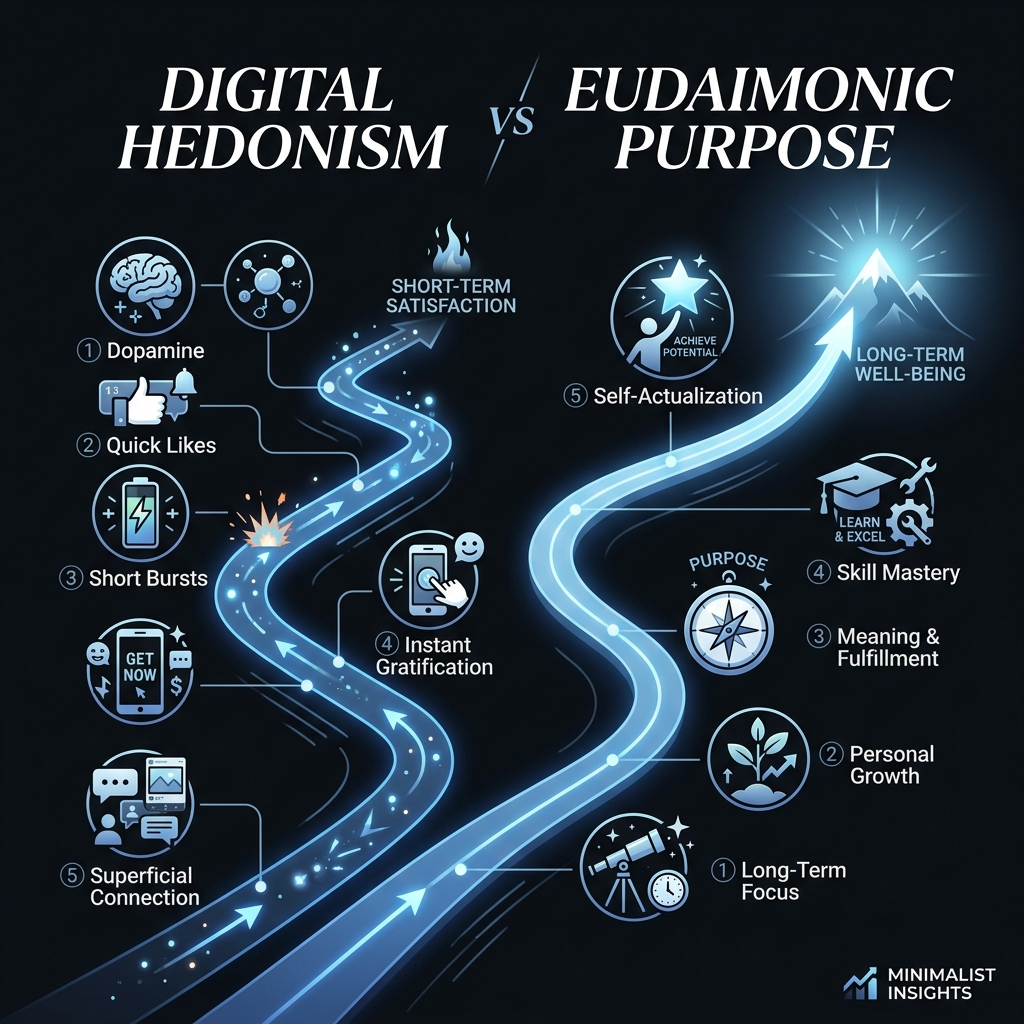
Two Paths of Reward: Hedonism versus Eudaimonia
Long before digital interfaces existed, ancient philosophy and modern behavioral science classified human motivation into two distinct domains.
- Hedonism prioritizes immediate pleasure while avoiding discomfort. A incoming notification or a brief video that triggers a quick laugh represents pure hedonic satisfaction—intense, fleeting, and rapidly forgotten.
- Eudaimonia targets long-term growth, deep meaning, and personal development projects whose rewards materialize only after months of sustained effort.
Modern platforms deliberately lean toward short-term stimulation. The dopaminergic pathway—the neural circuit prompting an organism toward anticipated reward—operates most effectively when feedback is immediate and unpredictable. This structure tilts human behavior toward extrinsic motivation, where actions become dependent on external cues rather than internal choice. The user rarely decides to return to the application conscious of a goal; the system summons them.
How Digital Hedonism Motivation Alters Human Behavior
When digital hedonism motivation dominates daily routines, the brain prioritizes rapid dopamine release over deep cognitive engagement. This shift mirrors patterns observed in other behavioral loops, where environmental cues trigger automatic responses before reflective thinking occurs.
Short-term hedonic triggers capture human attention by exploiting variable reward schedules, whereas eudaimonic engagement requires deliberate cognitive effort.
Algorithmic architecture relies on variable interval reinforcement. Because users cannot predict which swipe will yield interesting content, the brain remains in a perpetual state of anticipation. Much like earlier findings on digital intelligence, navigating these environments tests our executive function and self-regulatory capacity.
Maslow’s Hierarchy and the Illusion of Connection
Psychologist Abraham Maslow structured human needs into a classic hierarchy. A significant portion of social media activity attempts to satisfy two specific tiers of that pyramid: Esteem and Belongingness/Affiliation—the latter expanded by David McClelland.
Digital interactions offer a rapid, low-cost substitute for authentic connection. They create an illusion of social fulfillment without providing deep emotional nourishment.
The problem lies in this superficial satiety: it dampens the drive for authentic social contact before individuals reach the apex of the hierarchy, Self-Actualization.
Emotional Reactivity and Cognitive Traps
Human emotions act as navigational compasses. Theories such as the James-Lange theory and Schachter-Singer’s Two-Factor Theory explain how physiological arousal combines with cognitive appraisal to guide action.
On digital platforms, the sheer volume of emotional triggers intercepts attention before thorough appraisal can happen. Outrage, novelty, and social comparison activate immediate bodily reactions that dictate user behavior.
Effective digital engagement relies on Affectivity—the psychological capacity to observe and regulate emotional states without being automatically driven by them.
Reflecting on Your Personal Digital Habits
Consider what happens when you unlock your phone without a specific purpose. Do you feel a subtle urge to escape a quiet moment? That quiet friction highlights how digital hedonism motivation operates in quiet daily routines.
When encountering contentious material online, do you respond out of immediate emotional charge or take time for analytical reflection? Identifying these micro-patterns builds awareness around automated habits.
Every interaction in digital space reflects these underlying psychological trade-offs.
Unresolved Scientific Questions on Digital Well-Being
Researchers continue to investigate the long-term cognitive consequences of prolonged hedonic scrolling. While short-term behavioral metrics are well-documented, longitudinal studies tracking long-term shifts in attention span and eudaimonic well-being remain ongoing.
Future research aims to determine whether personalized digital environments can be designed to support sustained personal growth rather than exploiting immediate attention loops.
Uncertainty remains, yet understanding present mechanisms provides actionable clarity.
Reclaiming Intentional Choice
Eliminating digital tools is neither practical nor necessary. The core task involves rebalancing our daily motivation toward eudaimonic pursuits—using technology to learn, strengthen meaningful relationships, and expand personal capability.
Understanding the mechanics of digital hedonism motivation does not instantly neutralize automatic habits. It does, however, locate the control panel.
Primary Reference: Ryan, R. M., & Deci, E. L. (2001). On Happiness and Human Potentials: A Review of Research on Hedonic and Eudaimonic Well-Being. Annual Review of Psychology, 52(1), 141–166.
If this topic resonates with your experience or what you observe around you, there are other articles exploring the psychological mechanisms behind social media use in this space. Explore, question, and share with anyone who needs to read it.
Enjoyed this perspective? Deepen your understanding at Cyberpsychology Blog www.cyberpsychology.online