


Hamburg, April 2023. At CHI, the largest conference in the world on how people interact with computers, a team from Ludwig Maximilian University of Munich presented an experiment that would fit inside a coffee break.
Ten minutes of social media in the middle of a boring task.
The paper’s title read more like a headline than an abstract: short-form videos degrade our capacity to retain intentions. The research on short-form videos and prospective memory, the kind of memory that holds what you plan to do later, left the lab with a number that is hard to shrug off.
It also left with a caveat most coverage skipped. The phone, by itself, did no harm. The format did.
Sixty Volunteers and Three Color Words
Francesco Chiossi, Luke Haliburton, Changkun Ou, Andreas Butz and Albrecht Schmidt recruited 60 young adults, aged 19 to 34, all fluent in German. The main task was dull by design: strings of letters flashed on screen, and participants pressed a key to say whether each one was a real German word or a made-up one.
A second task ran underneath. Before starting, each person was handed three intentions. If “Blau”, “Lila” or “Grün” (blue, purple, green) appeared, they had to press a specific key instead of answering as usual. That is the textbook way to measure prospective memory in a lab: an intention stored away, waiting for the right cue.
Halfway through came the interruption. Ten minutes, four versions. A first group simply rested, no screens. Another scrolled their own Twitter feed. A third watched a YouTube video picked from a list. The last scrolled their own TikTok feed.
Then everyone went back to the task, and to the three colors they were supposed to remember.
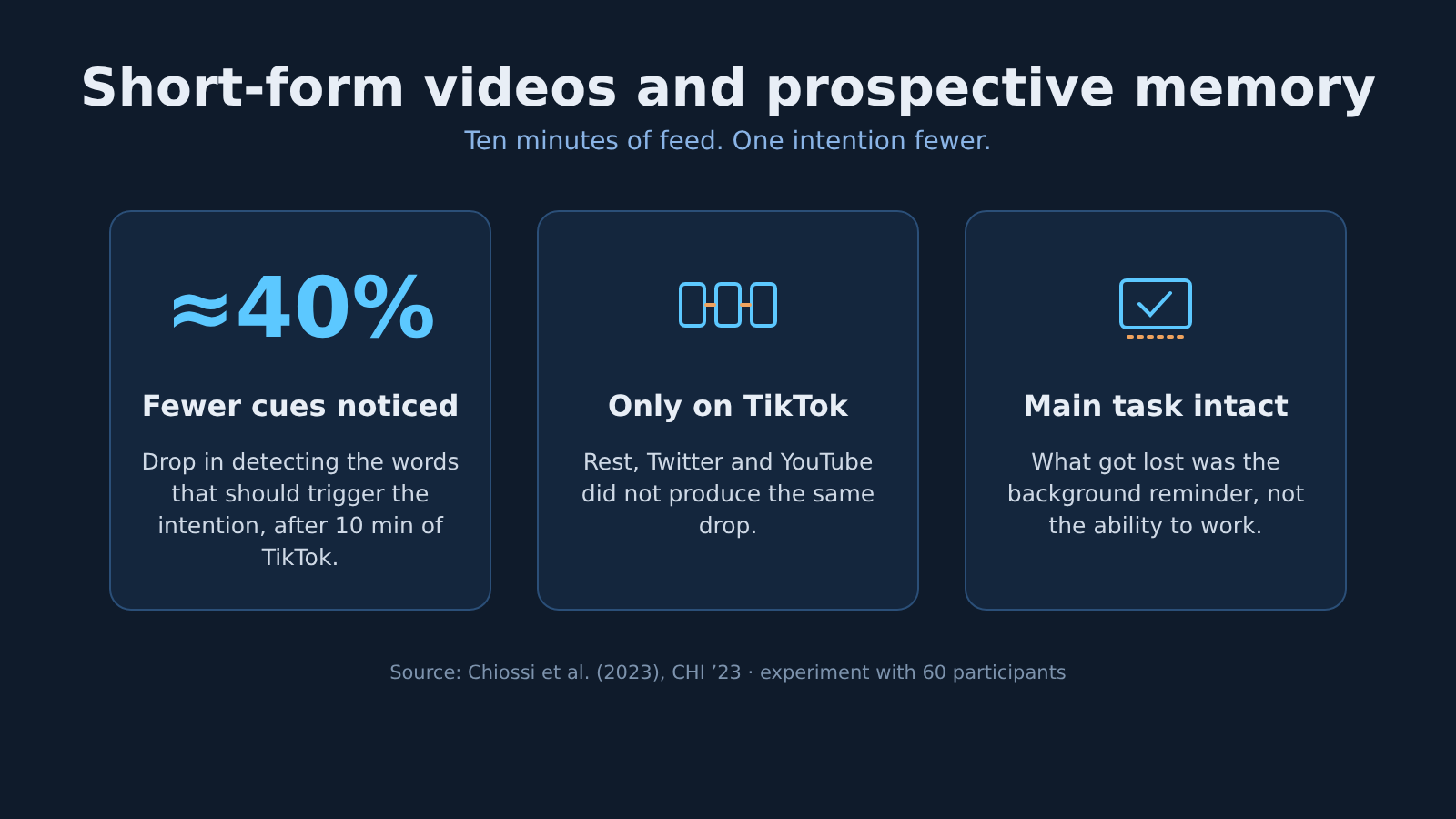
Only the people who spent those ten minutes on TikTok came back with a damaged intention: their detection of the cue words dropped by almost 40%.
One Group, One Steep Drop
The feed that knocked the plan loose
In the rest, Twitter and YouTube groups, performance on the color cues held steady from before the break to after it. In the TikTok group, it collapsed. The authors used a mathematical model that describes how each decision builds up until it becomes a response. After the interruption, the pull toward getting the cues right all but vanished. Hitting or missing became close to a coin flip.
The main task came through untouched
This is the most telling detail in the study. Accuracy at sorting words from non-words barely moved in any group. People returning from TikTok could still do exactly what was in front of them.
What went missing was what sat in the background.
Heavy users were not the explanation
The team also ran questionnaires on engagement, problematic social media use and absent-minded phone use. The four groups did not differ in any meaningful way on those measures. So the effect cannot be blamed on the most compulsive scrollers happening to land in the TikTok condition. These were ordinary people, with ten minutes of feed and one fewer intention.
What Every Swipe Costs
Prospective memory handles the “later”: take the pill at eight, send the email when the meeting ends, grab bread on the way home. It works in a peculiar way. Storing the intention is not enough. Something in the environment has to bring it back at the right moment, and there has to be some spare attention left to notice that cue when it passes by.
The authors name context switching as the prime suspect. A short-form feed changes topic, tone and emotion every few seconds. Ten minutes means dozens of small restarts, each demanding a full reorientation: who is this person, what are they laughing at, why should it matter.
Sophie Leroy, who studies attention at work, coined a term for what those switches leave behind: attention residue, the part of the mind still stuck on the previous task after the next one has begun. On a short-form feed, the residue never gets time to clear.
It piles up. That is where short-form videos and prospective memory collide.
Twitter also jumps between topics all the time, but in text, at the reader’s own pace. The YouTube group watched a single video with one continuous thread. Neither combined what TikTok combines: moving images and rapid switching.
The intention, in that setting, is not deleted like a file. It just stops being looked for.
A Note from a Computer Science Classroom in Brazil
This section steps out of the third person on purpose.
I trained in systems analysis, hold a master’s in computer science and teach computing at a federal technical institute in Brazil. When I read the Chiossi paper, the first image that came to mind was not from psychology. It was an operating system.
Every computer switches context constantly. It pauses one program, serves another, then returns to the first. That only works because, before each switch, the system saves the state of the interrupted program: where it stopped, what was left to do. Without that record, coming back would be a guess.
The mind has no guaranteed place like that for intentions. It bets that some cue will bring them back. The experiment suggests a short-form feed works like a context-switching machine with no state saving: dozens of interruptions in a row, none of them bothering to store what was pending.
In a school, the problem has a familiar face. The assignment deadline, the file that had to be uploaded, the “I’ll check later” at the end of class: all of that is prospective memory, and it lives on the same device the feed runs on. In Brazil, where a single messaging app often carries class groups, school notices and work schedules, that overlap is even tighter than the Munich lab could capture. It echoes what this blog has discussed about attention and social media.
I do not think the answer is to treat students as people lacking willpower. The authors themselves suggest digital reminders and feeds that mix formats. In a programmer’s terms: if the system does not save the state, someone has to save it for it. Writing the intention down outside your head before opening the app is a modest, cheap way to do exactly that.
Before You Open the App
Have you ever picked up your phone to do one specific thing and realized, fifteen minutes later, that you never did it?
Do you tend to remember the task only at night, already in bed, far from where it could be done?
After a run of short videos, do you feel your mind has “come back”, without quite knowing where it was headed?
None of these experiences is a diagnosis. They are snapshots of a memory that depends on cues, and on a bit of leftover attention to catch them.
The question worth keeping is a different one: what was pending in your head the last time you opened a feed without deciding to?
Short-Form Videos and Prospective Memory Beyond the Lab
Sixty people across four groups means fifteen per condition. That is small. Sorting German words is also a long way from real life, and the authors say so. The YouTube group did not use their own feed, which muddies the comparison. And the study cannot tell what matters most: the video format, the speed of switching or the combination.
Time is the bigger gap. The experiment measured ten minutes, not months. A 2026 systematic review by Arthi Efcibha Mona and colleagues gathered 23 studies on problematic short-video use and cognition in young people. Attention and self-control were the domains most affected. But 21 of those studies were correlational, and 20 were run in China.
The rest of the world is barely on the map. Since 2023, the format has also stopped belonging to a single platform: Instagram Reels and YouTube Shorts copied the logic. If the format is the problem, as the study suggests, the conversation is no longer about one app. It is closer to the question raised by the displacement hypothesis: not only what we do on screens, but what quietly gets pushed out.
Left Halfway Done
Ten minutes of feed did not take anyone’s ability to work. It took almost 40% of their chance of noticing the cue that should have triggered an intention.
The damage is small and silent, easy to mistake for distraction or laziness.
It might be something else. It might just be a system switching context too fast, with nowhere to store what was left halfway done.
Before the next video: what were you about to do?
Main reference: Chiossi, F., Haliburton, L., Ou, C., Butz, A., & Schmidt, A. (2023). Short-Form Videos Degrade Our Capacity to Retain Intentions: Effect of Context Switching On Prospective Memory. Proceedings of the 2023 CHI Conference on Human Factors in Computing Systems, ACM. https://doi.org/10.1145/3544548.3580778.
Further sources: Leroy, S. (2009). Why is it so hard to do my work? The challenge of attention residue when switching between work tasks. Organizational Behavior and Human Decision Processes, 109(2), 168–181. — Mona, A. E. et al. (2026). Short video addiction and its impact on cognitive functioning in adolescents and youth: a systematic review. International Journal of Adolescence and Youth, 31(1), 2623337.
If this topic resonates with your experience or what you observe around you, there are other articles exploring the psychological mechanisms behind social media use in this space. Explore, question, and share with anyone who needs to read it.
Enjoyed this perspective? Deepen your understanding at Cyberpsychology Blog www.cyberpsychology.online