


A tiny red dot sits in the upper corner of an app icon. Measuring only a few millimeters, this small visual element possesses a remarkable ability to derail ongoing conversations, interrupt focused work, and capture human focus. Studying digital perception and learning begins right at this interface boundary—not across the entire screen, but within micro-details that our visual system cannot easily ignore.
Understanding why these design choices command human attention requires examining basic sensory processing.
From Raw Visual Input to Cognitive Meaning
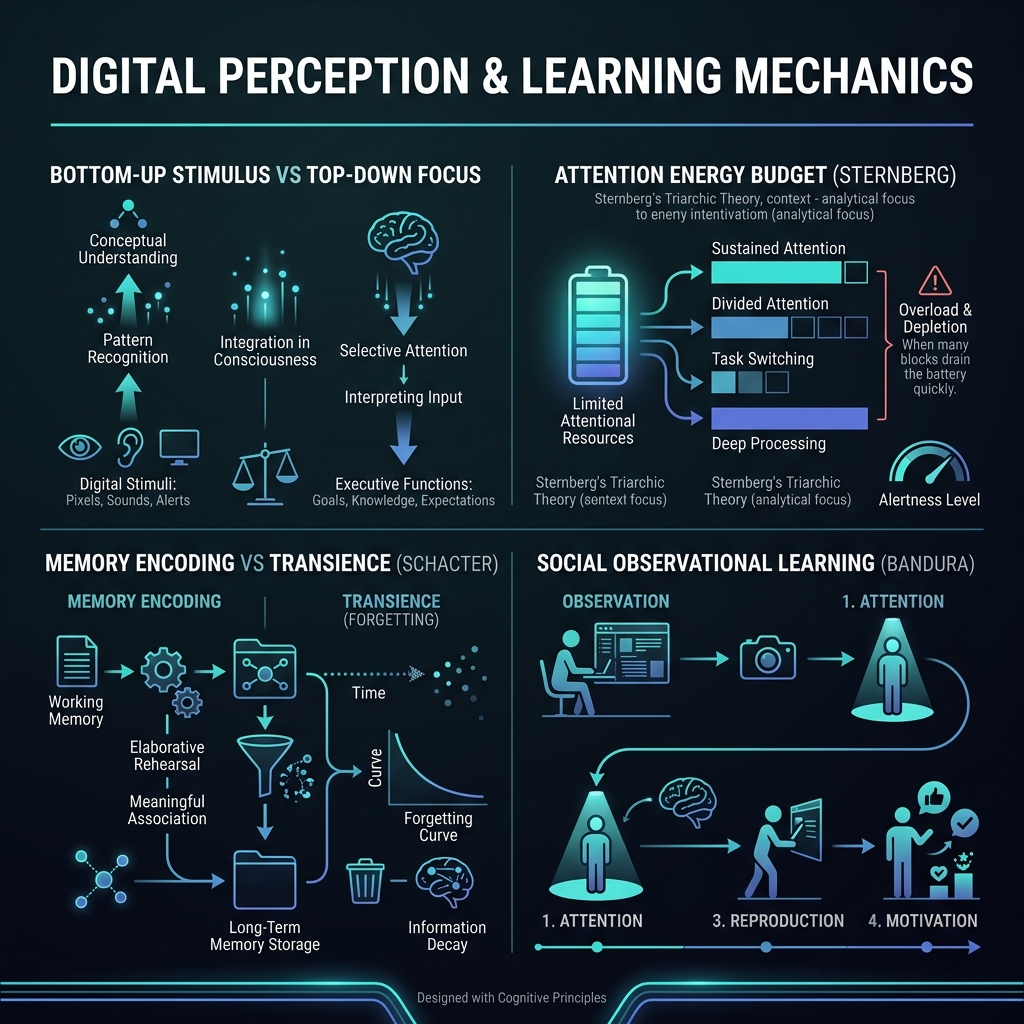
Information processing opens with Sensation: light patterns strike retinal cells without immediate interpretation. Perception represents the subsequent neural step, where the brain assigns meaning to sensory input. Neuroscientist Michael Gazzaniga outlines two primary pathways for processing incoming data:
- Bottom-Up Processing: A vibrant notification pops onto a dark screen, hijacking visual pathways automatically before conscious deliberation occurs.
- Top-Down Processing: A user actively searches for a specific message, directing executive focus to filter out extraneous visual noise.
Digital platforms leverage bottom-up pathways with exceptional efficiency. High-contrast badges, rapid animations, and sharp notification sounds are engineered to trigger automatic sensory capture. Top-down focus remains available, yet engaging it requires deliberate cognitive effort. Nobody triggers conscious focus by accident.
Attention as a Finite Energy Budget
Psychologist Robert Sternberg described human attention as a strictly limited resource, functioning much like an energy budget. Once expended, cognitive control degrades. The phenomenon commonly labeled multitasking—or divided attention—does not expand attentional capacity. It simply subdivides a static budget into smaller fragments, reducing overall performance across every active task.
Automatic routines like infinite scrolling consume minimal cognitive energy while producing negligible long-term knowledge, whereas deep comprehension requires active controlled processing.
When users fall into passive browsing, attentional reserves drain without yielding meaningful retention. Similar to mechanisms explored in digital hedonism motivation, automated interface cues capitalize on low-effort habits.
How Digital Perception and Learning Impact Memory Encoding
Scrolling through dozens of posts while retaining almost none of their contents is a widespread experience. Psychologist Daniel Schacter classified this phenomenon among fundamental memory transience errors, rooted primarily in absent-mindedness during initial encoding. Information that does not receive focused attention fails to consolidate into long-term memory structures.
Understanding how digital perception and learning function in fast-paced feeds reveals why shallow reading leaves minimal cognitive traces. Without active rehearsal, incoming facts decay within seconds.
The Dual Edge of Digital Social Learning
Despite attentional challenges, online platforms also facilitate Social Learning Theory as formulated by Albert Bandura. Humans learn extensively through observation—watching peers solve complex problems, following specialized educational channels, or modeling productive workflows.
Digital networks scale social observational learning to an unprecedented degree. The same infrastructure that enables rapid distraction also connects individuals to global knowledge communities and collaborative problem-solving.
As demonstrated in research on digital intelligence, modern cognitive performance depends less on raw information access and more on maintaining effective attentional filters.
Evaluating Your Daily Information Intake
Consider your own cognitive state after spending thirty minutes on a social feed. Do you remember specific insights, or do you experience a vague sense of mental fatigue?
Observing how digital perception and learning shape your daily routine provides a practical diagnostic. Identifying whether your attention was guided by top-down intention or bottom-up notification badges marks the first step toward intentional control.
Current Gaps in Cognitive Overload Research
Cognitive scientists continue to investigate how lifelong exposure to high-frequency notification environments influences baseline attentional control. Current empirical models effectively explain short-term cognitive strain, yet long-term structural impacts on deep reading capacity remain under active debate.
Further longitudinal studies are required to distinguish temporary mental fatigue from lasting changes in attentional architecture.
Steering Attention in High-Stimulus Ecosystems
The central challenge of connected environments stems not from digital technology itself, but from the speed at which it saturates evolutionary cognitive mechanisms designed for a slower physical world. Sensory and memory systems operate under familiar biological constraints; the volume and frequency of environmental input are what changed.
Grasping how digital perception and learning interact does not erase notifications or eliminate screen time. It restores agency—offering the user a deliberate choice over which cognitive pathway will direct their next half hour.
Primary Reference: Gazzaniga, M. S., Ivry, R. B., & Mangun, G. R. (2019). Cognitive Neuroscience: The Biology of the Mind. W. W. Norton & Company, 5th ed.
If this topic resonates with your experience or what you observe around you, there are other articles exploring the psychological mechanisms behind social media use in this space. Explore, question, and share with anyone who needs to read it.
Enjoyed this perspective? Deepen your understanding at Cyberpsychology Blog www.cyberpsychology.online