


2012.
The year itself appears unremarkable on paper. Yet 2012 marks the exact inflection point when adolescent depression, anxiety, and self-harm statistics ceased their gradual trajectory and surged upward. This sudden spike defined the reality of anxious generation social media teens across the Western world.
Social psychologist Jonathan Haidt documented this shift in The Anxious Generation (2024). As a professor at NYU Stern School of Business, Haidt spent decades examining moral psychology, emotion, and human development. His core thesis presents a stark reality: tech corporations executed an unvetted experiment on adolescent brains, and the societal repercussions are now visible.
Two Forces Restructuring Modern Childhood
Haidt defines this cultural turning point as the Great Rewiring of Childhood: the rapid transition between the late 1980s and mid-2010s from a play-based childhood to a phone-based childhood.
This transformation represents far more than kids spending excess hours staring at touchscreens. It constitutes a structural shift in the sensory and social inputs that a developing brain receives—or fails to receive.
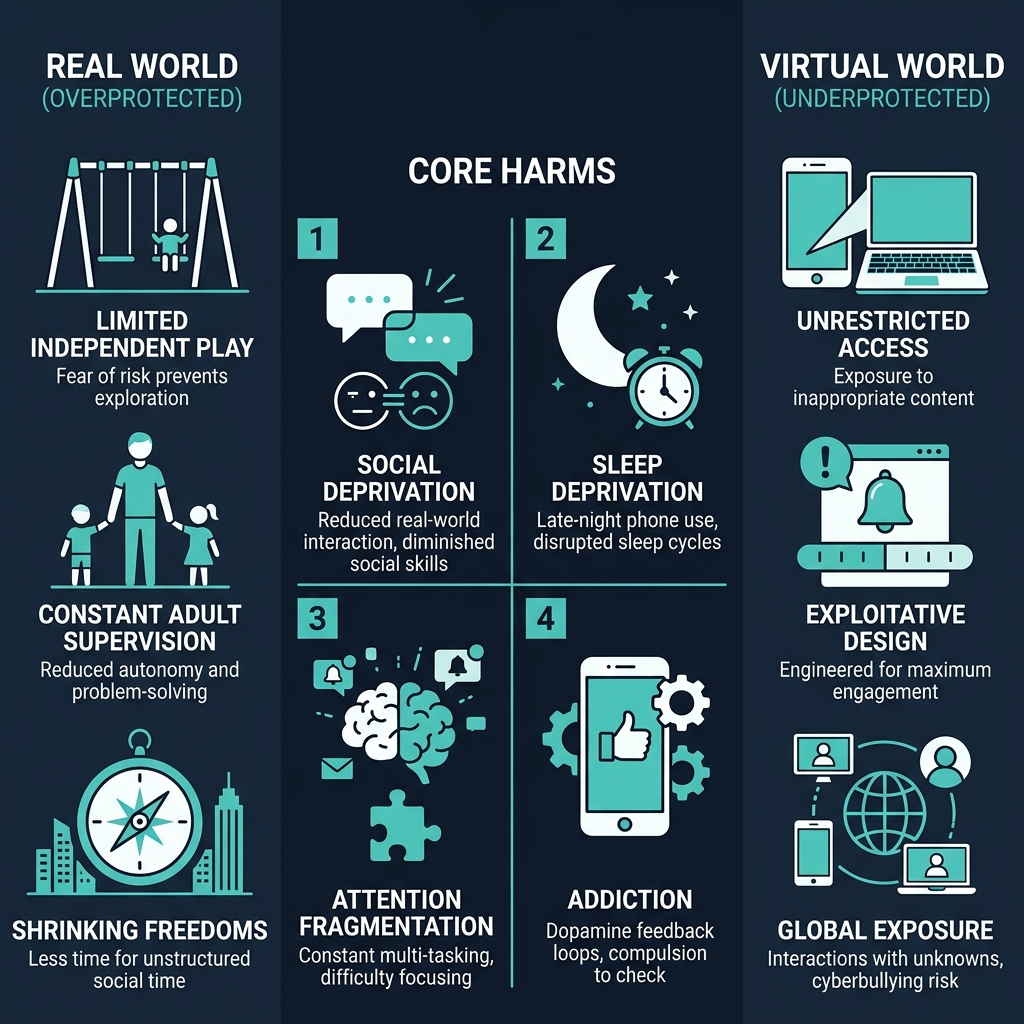
Two opposing societal vectors collided simultaneously.
Overprotection in the physical realm. Beginning in the late 1980s, parents progressively curtailed unsupervised free play due to heightened fears of abduction, physical harm, or emotional distress. Independent bike rides, unsupervised park visits, and self-managed peer disputes largely vanished from daily life.
Underprotection in the digital realm. Concurrently, parents granted unrestricted access to virtual spaces. Without age verification or time boundaries, smartphones became permanent digital babysitters. For millions of anxious generation social media teens, connected devices replaced physical environments as primary social arenas.
“The central claim of these pages is that these two trends—overprotection in the real world and underprotection in the virtual world—are the main reasons why children born after 1995 became the anxious generation.”
— Jonathan Haidt
The 2012 Threshold and Tech Acceleration
Psychologist Jean Twenge, analyzing generational data alongside Haidt, confirmed that mental health metrics did not rise along a gentle curve. They doubled.
The year 2012 was not coincidental. Smartphone adoption among adolescents crossed a critical mass threshold that year. Facebook acquired Instagram, sparking explosive user growth. Front-facing cameras became standard smartphone hardware, establishing selfie culture as a social norm.
The technological sequence that rewired adolescent life:
- 2007: iPhone launch — personal computing enters the pocket
- 2009: Like and Share buttons — social evaluation becomes quantitative and viral
- 2010: Front-facing cameras — continuous self-monitoring and visual broadcast
- 2012: Instagram acquisition — peer comparison shifts toward visual appearance
Four Core Harms Fueling Adolescent Distress
Haidt categorizes the structural damage inflicted upon anxious generation social media teens into four distinct developmental impairments.
1. Social Deprivation
Screen interaction cannot replicate embodied human connection. Natural human sociality relies on three evolutionary pillars:
- Embodied presence — reading facial micro-expressions, vocal tone, physical posture, and touch.
- Synchronous feedback — real-time conversational timing that text messages flatten.
- High-cost community membership — relationships require physical investment, making abrupt exit costly.
Digital messaging fails to recruit the neural circuits required for social bonding. Replacing physical co-presence with continuous feeds leaves anxious generation social media teens socially isolated despite constant connectivity.
2. Sleep Deprivation
Midnight notifications, algorithmic video queues, and fear of missing out disrupted adolescent sleep architecture. Sleep is not a passive leisure activity for teenagers; it is the vital window when the brain consolidates memory, processes emotional trauma, and executes developmental maintenance.
3. Attention Fragmentation
Digital platforms intentionally exploit cognitive vulnerabilities to maximize screen time. Algorithms deliver variable rewards, unpredictable novelty, and emotionally provocative content. This design creates a state of continuous partial attention, impairing deep focus and reflective thinking.
Attention is the foundational cognitive resource. As discussed in our analysis of digital perception and learning, overloading working memory limits intellectual depth and emotional self-regulation.
4. Behavioral Addiction
Popular social applications were engineered for maximum engagement rather than youth safety. The dopaminergic reward pathway—evolved to reinforce survival behaviors—is repeatedly triggered by notifications and infinite scrolling. As explored in our work on digital hedonism motivation, short-term dopamine loops override long-term goal pursuit.
Differential Impact Across Gender Dynamics
Mental health data highlights a clear divergence: the psychological downturn affected adolescent girls earlier and with greater severity.
Visual social platforms exploit female relational dynamics. Girls historically invest in deep dyadic friendships and exhibit higher sensitivity to social inclusion and peer judgment. Instagram and TikTok transformed visual appearance and social standing into public currencies.
Conversely, boys experienced harm through different digital channels: video game compulsions, pervasive online pornography, and withdrawal from real-world achievements into virtual environments.
Antifragility and the Loss of Psychological Immunity
To illustrate developmental necessity, Haidt draws upon Nassim Taleb’s concept of antifragility—systems that require stressors to grow stronger.
Human children are inherently antifragile. A developing nervous system expects moderate real-world challenges: minor playground conflicts, temporary exclusion, physical risks, and negotiation. These experiences act as psychological vaccines, building emotional resilience and frustration tolerance.
+----------------------------------------------------------+
|                 DEVELOPMENTAL STRESS CURVE               |
|                                                          |
|   Growth ^               [ Optimal Zone ]                |
|          |                 Moderate Acute                |
|          |                   Stressors                   |
|          |                  /          \                 |
|          |                 /            \                |
|          |    [ Sub-Dev ] /              \  [ Chronic ]  |
|          |    Deprived   /                \  Digital     |
|          |    Real World                  \  Overload    |
|          +---------------------------------------------> |
|               Zero Stress               Chronic Stress   |
+----------------------------------------------------------+
Depriving children of real-world exposure while subjecting them to digital environments creates a double vulnerability: teens lack real-world coping mechanisms while enduring continuous online evaluation.
Developmental psychologist Laurence Steinberg documented that moderate acute stress fosters cognitive growth, whereas chronic low-grade stress causes neurobiological harm. Social feeds generate chronic micro-stressors by design.
The Z-Axis: Restoring Shared Meaning
Haidt introduces the Z-Axis of human experience: a moral and spiritual dimension ranging from sacred elevation to digital degradation.
Drawing on sociologist Émile Durkheim, Haidt argues that virtual environments suppress six essential human practices:
- Shared sacredness and collective rituals
- Physical embodiment and sensory presence
- Stillness, silence, and sustained contemplation
- Self-transcendence beyond ego-driven metrics
- Forgiveness and conflict resolution
- Experiences of profound awe in nature
Durkheim identified collective effervescence—the euphoric unity experienced during shared physical gatherings—as essential for social cohesion. Virtual networks do not build community; they generate hyper-connected crowds without shared embodiment or lasting solidarity.
Reclaiming Childhood Through Collective Action
Solving this crisis requires overcoming a classic collective action problem. An individual family attempting to delay smartphone adoption faces immense social friction when peer groups operate entirely online.
Coordinated systemic intervention is necessary across three domains:
Policy & Tech Industry Reform:
– Enforce genuine age verification mechanisms
– Restrict algorithmic recommendation feeds for minors
– Mandate safety-by-design standards (Age Appropriate Design Code)
Educational Institutions:
– Maintain phone-free school days to restore peer interaction
– Expand outdoor play, physical education, and hands-on projects
– Rebuild collective rituals that foster belonging
Family Norms:
– Delay internet-connected smartphones until age 14
– Restrict social media platform access until age 16
– Restore real-world independence through unsupervised play and neighborhood exploration
Non-Negotiable Human Requirements
The resolution does not demand rejecting technology. It requires honoring biological imperatives that cannot be traded away for algorithmic convenience.
Just as altered gravity would distort a child’s bone development, the artificial environment of social feeds distorts nervous system maturation, self-esteem, and emotional health.
The mental health crisis among anxious generation social media teens is not a failure of individual character. It is the predictable outcome of subjecting youth to an environment designed without regard for human development.
If this topic resonates with your experience or what you observe around you, there are other articles exploring the psychological mechanisms behind social media use in this space. Explore, question, and share with anyone who needs to read it.
Enjoyed this perspective? Deepen your understanding at Cyberpsychology Blog www.cyberpsychology.online
Main reference: Haidt, J. (2024). The Anxious Generation: How the Great Rewiring of Childhood Is Causing an Epidemic of Mental Illness.