


Public debates surrounding youth and technology usually entrench themselves in two hostile camps. In one camp, digital devices are painted as the root of all modern adolescent suffering. In the other, online life is merely a harmless evolution of socialization, and adult panic is just history repeating itself.
Neither side captures what empirical data actually reveals.
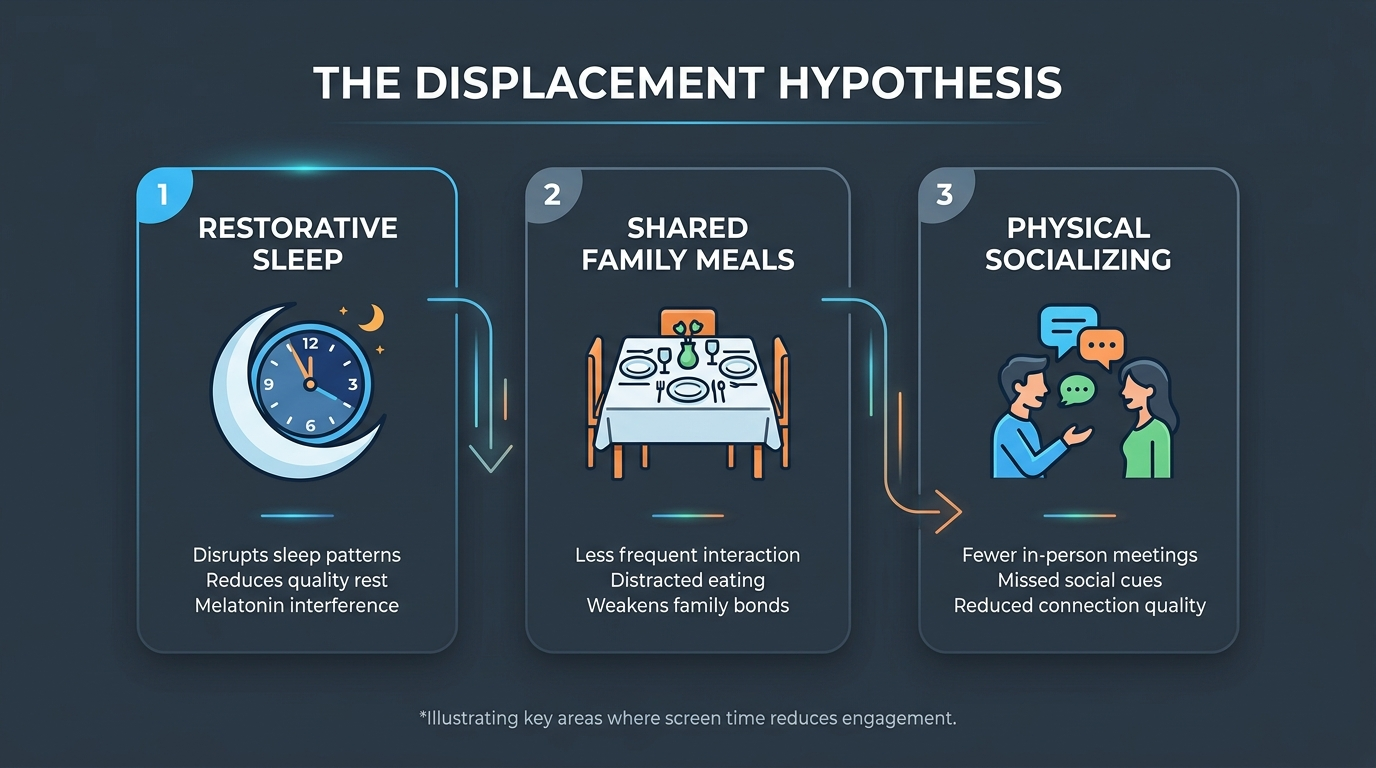
Dr. Jason Nagata, a pediatrician and clinical researcher at the University of California, San Francisco, has spent years examining large cohorts within the Adolescent Brain Cognitive Development (ABCD) Study. His work pursues a distinct angle: the critical damage rarely stems from the specific pixels on screen. The true damage happens through the displacement hypothesis social media framework—the silent eviction of essential human activities from daily life.
The Zero-Sum Arithmetic of Digital Attention
Discussions about screen time routinely fixate on toxic content: cyberbullying, distorted beauty standards, algorithmic outrage, and viral disinformation. While those factors carry undeniable weight, focusing exclusively on content obscures an elementary arithmetic truth.
Time is strictly zero-sum.
An hour surrendered to an algorithmic feed cannot be spent sleeping, sharing a meal, or walking with a friend. The displacement theory posits that the primary harm of hyperconnection is not what screens show our children, but what screens push out of their schedule.
Nagata and his colleagues identify three primary casualties.
Sleep: The Brain Under Invisible Vigilance
Sleep represents the most severe disruption in the pediatric data. Bringing a smartphone into the bedroom converts what should be a window of neural recovery into a state of chronic vigilance.
One specific detail from the ABCD Study stands out. Setting a smartphone to silent mode still degrades sleep architecture when compared to turning the device off and removing it from the bedroom entirely. The adolescent brain remains in active anticipation of notifications even when no chime sounds. Blue light suppresses melatonin, but anticipatory arousal keeps the nervous system awake.
Family Meals: The Lost Barometer of Satiety and Connection
The kitchen table has historically served two protective functions: an emotional barometer for parents and a biological regulator of satiety.
Replacing shared dinners with isolated snacking in front of streaming feeds breaks this developmental anchor. When eating occurs in a state of absorbed distraction, the brain registers fullness far too late, increasing the risk of disordered eating patterns while severing daily parent-child check-ins.
Physical Presence: Micro-Expressions in a Text-First World
Digital messaging offers the illusion of continuous intimacy, yet it strips away non-verbal nuance.
Text bubbles cannot train the developing brain to decode subtle micro-expressions, shifts in vocal cadence, or physical posture. Those physical signals form the bedrock of deep empathy and affect regulation. When online interaction displaces physical playtime, adolescents lose the safe friction needed to build social resilience, a dynamic also evident in our review of anxious generation social media teens.
“The central trap is rarely the specific content an adolescent consumes; it is the vital foundation of sleep, physical routine, and unmediated human presence displaced by digital immersion.”
— Dr. Jason Nagata, UCSF
Unraveling Cause and Effect in the ABCD Study
The standard scientific objection to screen time research has always centered on reverse causality. Critics ask: do social networks cause depression, or do distressed teenagers simply withdraw into digital feeds for solace?
The longitudinal structure of the ABCD Study allows researchers to resolve this ambiguity. By tracking thousands of adolescents across multiple consecutive years, Nagata’s team measured within-person variations, allowing each participant to serve as their own statistical control.
The findings are unambiguous.
Individual spikes in social media usage in a given year reliably predicted heightened depressive symptoms during the following year. The reverse relationship did not emerge with comparable statistical strength. Prolonged exposure produces an independent negative effect, operating largely through downstream biological disruptions like chronic sleep loss.
This relentless feedback loop echoes the systemic friction we analyzed regarding digital perception and learning.
When Connection Serves as a Lifeline
Pediatric research does not endorse blanket digital bans, and the reason is grounded in empirical nuance. If networked technology were purely toxic, its total removal would serve as an effortless cure.
Clinical reality proves far more complex.
Certain adolescent groups derive measurable psychological support from online platforms:
- Marginalized Identities: LGBTQ+ youth living in isolated rural communities and adolescents managing rare medical conditions frequently find their only validating peer group online.
- Destigmatizing Mental Health: Open discussions by public figures and supportive communities help dismantle long-standing stigmas surrounding depression and neurodivergence, frequently prompting teens to seek clinical support.
Depriving vulnerable youth of their digital lifelines creates isolation rather than safety. The objective must be protecting biological routines without severing authentic peer bridges.
An Architectural Perspective: Beyond the Toxic Content Narrative
As computer scientists and interface designers understand, modern platforms are not passive conduits of information. They are behavioral engines engineered to minimize natural exit points.
In software engineering, friction reduction is considered the ultimate virtue. Infinite scroll, auto-play, and push notifications were deliberately designed to eliminate the cognitive pauses where a user might decide to sleep or eat. When a system removes all boundaries, blaming an adolescent’s willpower reflects a fundamental misunderstanding of incentive architecture.
In educational and family contexts, the displacement effect compounds quietly. When smartphones sit on study desks, rapid task-switching erodes working memory capacity. The issue is not that the student is morally distracted; it is that the cognitive architecture required for deep reasoning cannot compete with variable dopamine schedules.
Understanding the displacement hypothesis social media shifts our focus from policing content to restoring architectural boundaries in our living spaces, moving away from what we described as golden cages digital freedom.
Practical Guardrails for Families and Classrooms
Translating pediatric evidence into household and educational routines requires clear, structural rules rather than vague digital detox pledges.
- The Bedroom Threshold: Keep all smartphones and tablets outside sleeping quarters overnight. A standalone alarm clock remains the most cost-effective mental health intervention available.
- Adult Role Modeling: Pediatric data indicates that the strongest predictor of adolescent screen habits is parental screen behavior. Demanding screen-free dinners while answering corporate messages at the table guarantees failure.
- Transparent Architectural Literacy: Talking candidly with young people about how algorithms monetize attention disarms defensive reactions. Discussing commercial intent and dopamine loops fosters genuine autonomy, aligning with principles of digital hedonism motivation.
The Core Question Behind the Screen
Regulating the digital environment does not require technophobic panic or unrealistic abstinence. It requires recognizing which fundamental human needs cannot be digitized.
Reclaiming restorative rest and shared physical presence does not mean rejecting the internet. It means ensuring that digital tools serve human development rather than devouring the time required to sustain it.
The decisive question for parents and educators is straightforward: what essential life experience was pushed out of today to make room for the feed?
Main reference: Nagata, J. M., et al. (2025). Social Media Use Trajectories and Cognitive Performance in Adolescents. JAMA, 333(8), 712–721.
If this topic resonates with your experience or what you observe around you, there are other articles exploring the psychological mechanisms behind social media use in this space. Explore, question, and share with anyone who needs to read it.
Enjoyed this perspective? Deepen your understanding at Cyberpsychology Blog www.cyberpsychology.online