


The most effective enclosure carries no barbed wire or stone walls. It rewards occupants with steady streams of applause, digital validation, and the comforting sensation of autonomy. This tension defines the paradox of golden cages digital freedom in hyper-connected society.
Analytical psychologist Waldemar Magaldi Filho posed an uncomfortable question in a celebrated 2026 essay: “Are we genuinely free, or do we live trapped inside golden cages?” The answer challenges conventional assumptions about career success, consumer choice, and digital connectivity.
When algorithmic systems anticipate human desires before individuals consciously register them, questioning who built the environment becomes essential.
The Invisible Architecture of Modern Confinement
Contemporary systems rarely enforce compliance through overt coercion. They operate through gilded incentives—systems so finely crafted and socially praised that individuals mistake adaptation for genuine liberation.
Magaldi outlines how cultural structures reward total immersion. When someone feels accomplished, busy, and validated within an enclosure, that pleasant sensation does not prove freedom. It frequently signals seamless accommodation to systemic demands.
Sociologists term this condition normosis—the uncritical normalization of dysfunctional social patterns. When everyone around you runs the same frantic race, running faster feels like self-determination.
“We call this ‘choice’ and ‘success.’ We feel useful and accomplished within these structures. Yet this feeling of well-being is not proof of freedom. It is often the symptom of deep adaptation to one’s own prison.”
— Waldemar Magaldi Filho
Four Enclosures Defining Golden Cages Digital Freedom
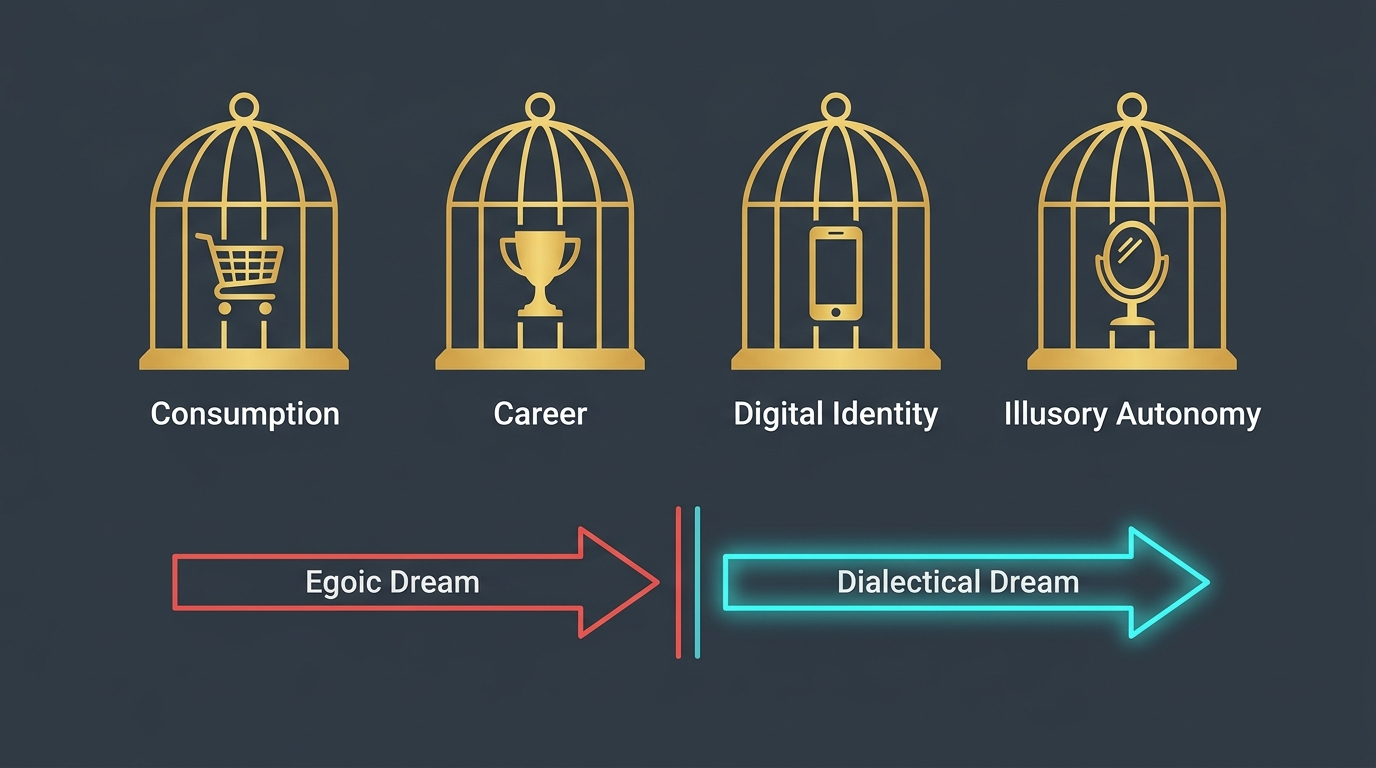
Modern society erects four distinct enclosures that channel human energy into endless cycles of performance.
The Trap of Material Consumption
Possessions are routinely acquired to soothe existential unease that physical objects cannot resolve. Consumer culture calibrates desire so that satisfaction dissolves faster than the anticipation of the next acquisition. The individual remains locked in a relentless treadmill of earning and purchasing, mistaking spending power for agency.
The Treadmill of Endless Career Status
Professional environments frequently demand the surrender of personal vitality in exchange for corporate prestige and titles. Chronic exhaustion becomes a badge of dedication. Burnout arrives as the predictable consequence of equating institutional utility with intrinsic worth.
The Curated Fortress of Digital Identity
This constitutes the most subtle barrier of the digital era. Users build and polish an online persona engineered to appease algorithmic distribution and collect peer approval. Managing this personal brand turns into an unpaid second shift: performing without a backstage, where private life is continuously converted into public content.
The Deception of Isolated Autonomy
Hyper-individualism preaches that true strength means needing no one. Yet cutting relational ties produces isolation rather than sovereignty. Swapping deep community bonds for self-sufficient detachment represents the loneliest cage of all.
How the Literalizing Ego Fuels Algorithmic Feedback
At the center of these four structures operates a psychological mechanism well known in clinical practice: the literalizing ego.
Rather than tolerating life’s nuance, vulnerability, and unpredictability, the ego reduces existence to quantifiable objectives: winning, accumulating, outperforming. Metrics replace meaning. Products replace experiences. The curated profile replaces the living person.
In psycho-cybernetics, Maxwell Maltz showed how the human servo-mechanism falters when fed distorted feedback. When self-worth depends entirely on external appraisal, the internal navigation system enters chronic failure mode. The internal thermometer measures the wrong room entirely.
Digital platforms amplify this vulnerability on an industrial scale. Likes, shares, and algorithmic visibility deliver immediate reinforcement that one is heading in the right direction—even when that direction leads deeper into confinement.
As explored in our analysis of digital hedonism motivation, variable dopamine loops hijack reflective volition. Platforms do not optimize human flourishing; they maximize retention, and retention thrives on subtle anxiety.
This dynamic deepens the cognitive overload examined in research on digital perception and learning. Furthermore, as Jonathan Haidt documented regarding anxious generation social media teens, entire generations were socialized inside these architectures during vulnerable developmental periods.
Examining the Bars of Your Daily Routine
None of these observations serve as clinical diagnoses. They are reflective checkpoints to carry into your day.
Have you ever experienced a brief rush from a high-performing post, followed moments later by unexplained hollow fatigue?
Do you find yourself framing personal memories in terms of how they might look on a public feed?
When was the last time you engaged in an activity without measuring its productivity, shareability, or status yield?
These questions do not condemn your habits. They illuminate where personal agency ends and platform design takes over.
The Frontier Where Philosophy Meets Empirical Data
Philosophical critique highlights systemic blind spots, yet empirical cyberpsychology reminds us that digital engagement is rarely all-or-nothing.
Connected technology provides genuine avenues for collaboration, community support, and cognitive expansion, as detailed in our review of digital intelligence. The challenge stems from unexamined immersion in reward loops built without regard for human psychological limits.
Researchers increasingly emphasize ecological assessments to understand how algorithms shape self-concept across long time horizons. Recognizing the structural design of digital spaces allows users to cultivate conscious boundaries rather than reactive withdrawal.
Awakening from the Curated Trance
Stepping beyond an enclosure does not require radical asceticism or cynical detachment. It begins with clear perception.
Magaldi contrasts two guiding orientations:
- The Egoic Dream: Possession, status dominance, and private accumulation—a disguised retreat from real engagement.
- The Dialectical Dream: Transformation, solidarity, and authentic connection—the understanding that meaning grows through relationships rather than isolated competition.
Touching the bars of the cage initiates de-hypnotization. It marks the moment an individual stops sleepwalking through rewarded routines and begins to choose consciously.
Understanding golden cages digital freedom does not dissolve every constraint overnight. It simply returns agency to its rightful place.
The decisive question is not whether you are successful in the arena. It is this: who designed the arena you are spending your life trying to win?
Main reference: Magaldi Filho, W. (2026). Somos livres ou vivemos presos em celas douradas?. Folha de S.Paulo, Ilustríssima.
If this topic resonates with your experience or what you observe around you, there are other articles exploring the psychological mechanisms behind social media use in this space. Explore, question, and share with anyone who needs to read it.
Enjoyed this perspective? Deepen your understanding at Cyberpsychology Blog www.cyberpsychology.online