
Ninety-eight percent.
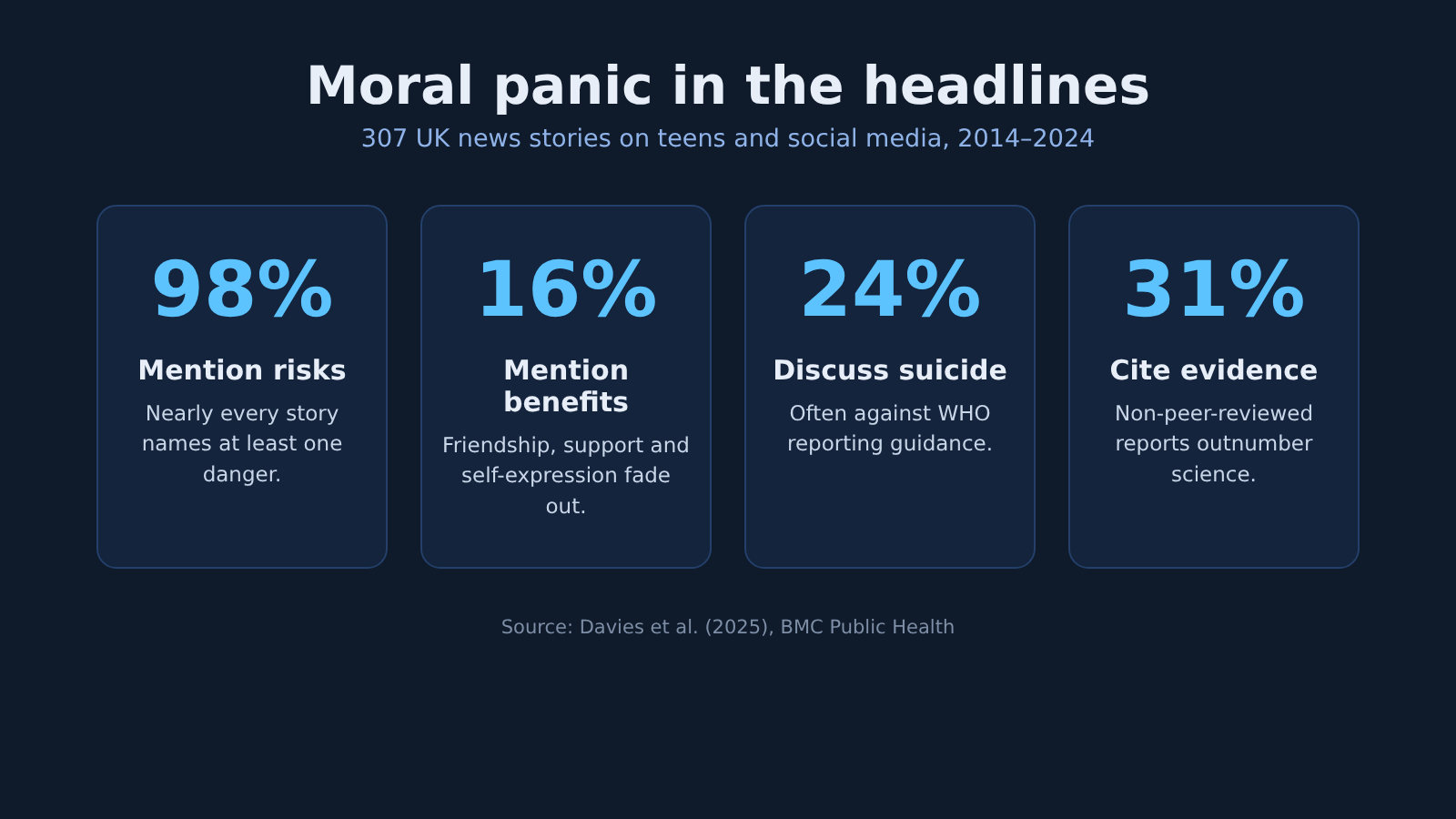
That is the share of British news stories about teenagers and social media that mention at least one risk. The share that mentions any benefit at all: sixteen percent. The figures come from 307 articles published over a decade of UK reporting, and together they draw the sharpest picture yet of something many parents feel but rarely see measured — the moral panic over social media.
None of this proves that social media is harmless. It proves something else, and arguably something more uncomfortable.
The story adults are told about their children’s digital lives has been written with a crooked ruler.
Three Hundred Stories Under the Microscope
Jade Davies and four colleagues at the University of Manchester flipped the usual research question. Instead of studying teenagers, they studied the news about teenagers.
The team searched the Factiva news database and the BBC News website for articles published between 2014 and mid-2024. Out of nearly 600 candidates, 307 discussed the risks or benefits of adolescent social media use. Each one was read and coded by the researchers: the tone of the headline, the risks named, the benefits named, who got quoted, and what evidence backed the claims. The protocol was pre-registered, and the paper appeared in BMC Public Health in 2025.
The authors’ verdict: the coverage builds a dominant narrative of panic, framing social media as a fundamental threat to adolescents while engaging very little with the research evidence.
How the Papers Kept Score
Risks Almost Always, Benefits Almost Never
More than half of the headlines (58%) were negatively framed. Positive ones made up 3%. Tabloids leaned negative more often than broadsheets, and right-leaning papers more often than left-leaning ones.
Inside the articles, 84% discussed risks alone. Mental health topped the list, followed by harmful content, online conflict and inappropriate contact with adults. When a benefit did appear — friendship, support, a place to express oneself — it usually came with a “but” attached.
Mechanisms that researchers actually debate got little airtime. Among stories about mental health, fewer than 3% mentioned social media displacing healthier activities, the core idea behind the displacement hypothesis. A quarter named no mechanism at all.
One in Four Stories Mentioned Suicide
This is the most serious finding. About 24% of all the articles linked social media to suicide or suicidal thoughts, and two-thirds of those revolved around a single, widely publicized case.
Reporting on it is not the problem. The manner is. The authors found stories that reduced a death to being “hooked” on a phone, that mentioned methods, and that used dehumanizing labels for the girl who died. That is close to a checklist of what the World Health Organization’s guidance for media professionals asks journalists to avoid.
There are names for what is at stake. The Werther effect is the rise in risk through imitation after sensational coverage of suicide. Its counterpart, the Papageno effect, is the protective influence of stories about people who went through a crisis and found help.
This is a sensitive topic. If you are struggling, in the US you can call or text 988; elsewhere, findahelpline.com lists free, confidential services by country.
Evidence Cited, Evidence Hidden
Only 31% of the stories used any research at all. Among the references they did use, reports from charities and government bodies — known as grey literature, which skips peer review — showed up almost twice as often as academic studies.
Fewer than half of those references gave readers enough detail to find the source. Just 18% mentioned any limitation of the research being cited.
Who Speaks, and Who Is Spoken About
Officials, charities and family members were quoted most, and they tended to talk about risk. Young people themselves appeared in only 16% of the articles that used quotes. Along with researchers, they were also the most likely to mention a benefit.
Why Moral Panic Over Social Media Travels So Well
Sociologist Stanley Cohen coined the term moral panic in the early 1970s to describe a recurring pattern: a group or practice comes to be seen as a threat to social order, the press amplifies the fear, and authorities respond in ways that deepen the sense of crisis.
Technology is a repeat candidate. The eighteenth century worried about “reading addiction.” In the 1940s, radio was the culprit. Then came television and video games. The study suggests social media now fills that slot, and the debate around books such as The Anxious Generation shows how much energy the topic carries.
Politics follows the headlines. The authors point to Australia’s late-2024 law banning social media for under-16s and to the US Surgeon General’s calls for stronger protections as signs of how fast the restrictive mood is spreading. Some of these measures respond to real risks. The paper’s worry is that blanket bans skip the harder question of what the evidence actually supports.
There is a commercial engine, too. A frightening headline earns more clicks than a longitudinal study, which tends to conclude something hard to sell: the link exists, it is small, and it depends on context and on who is being studied. The authors note that research following the same young people over time often finds no direct effect of social media use on mental health, and that some studies point the other way — distress leading to more use.
Panic simplifies. A single cause is easier to fight than bullying, family conflict, inequality and poor access to mental health care, all factors that research on youth suicide has documented for decades.
From the Front Page to the Family Table
The authors borrow Bronfenbrenner’s ecological model to trace the route. The press acts from a distance, but its influence lands close to home: it shapes what parents fear, what schools ban and what lawmakers vote for.
Have you ever taken an app away from someone, or from yourself, because of a headline rather than something you actually noticed?
Have you ever felt guilty about a good moment on your phone, as if it were a symptom?
On that second point, the researchers raise a troubling possibility. Teenagers who constantly hear that social media is bad for them may start blaming it for every low mood, and the expectation becomes part of the effect.
Taking a phone away out of generic fear is not the same as sitting next to someone and asking what that video helps with after a rough day.
Turning the Mirror Around
This section is written in the first person, on purpose.
Reading this study bothered me for a simple reason: it applies to me too. This space has spent months writing about the risks of social media — compulsive use, anxiety, sleep, attention. If someone held my articles to the same ruler Davies held to British newspapers, how many would mention a benefit? How many would state the limits of the study they cite, and not just its most striking finding?
I don’t know the exact answer. I suspect it is not a comfortable one.
What changed is the commitment. Before accepting a headline, or writing one, I want to run it past three questions: who was heard? Which study, and where can I read it? What limits do the authors themselves admit? If a story answers none of them, its urgency deserves suspicion.
I have one more suspicion the study does not test. It analyzed newspapers, with links, bylines and editors. A great deal of what parents hear about kids and screens, though, arrives as a screenshot of a headline forwarded in a family group chat, with no link at all. In that format, the 31% of stories that cite any evidence effectively drop to zero, because there is nothing to click. If newspapers start the panic, forwarding may concentrate it.
Where the Study Stops
The paper is clear about its boundaries. It covers only the British press, during a decade marked by high-profile tragedies and by legislative debates on online safety — coverage peaked in 2019, the year the UK government published its Online Harms White Paper. It did not examine TV news or reader comments.
The headlines were also classified by adults. The authors acknowledge that teenagers might read the same headlines differently, and they recommend bringing young people in as collaborators in future analyses.
None of this erases real risks. Harmful content, harassment and predatory adults show up in the data because they exist. The critique is about proportion, not existence.
Neither Alarm Nor Anesthesia
The threat does not lie only in what screens show. It also lies in how headlines teach us to read those screens, through a narrative that leaves out the voices of the people who actually live inside them.
Reading the news calls for the same critical sense as scrolling a feed.
The next time an urgent headline about teens and social media lands in your inbox, it is worth asking: who, in that story, was allowed to speak about their own life?
Main reference: Davies, J., Cadwallader, S., Black, L., Hickman Dunne, J., & Panayiotou, M. (2025). The representation of adolescent social media use: a systematic review and content analysis of UK newspaper articles. BMC Public Health, 25, 3067. https://doi.org/10.1186/s12889-025-23897-5.
If this topic resonates with your experience or what you observe around you, there are other articles exploring the psychological mechanisms behind social media use in this space. Explore, question, and share with anyone who needs to read it.
Enjoyed this perspective? Deepen your understanding at Cyberpsychology Blog www.cyberpsychology.online