

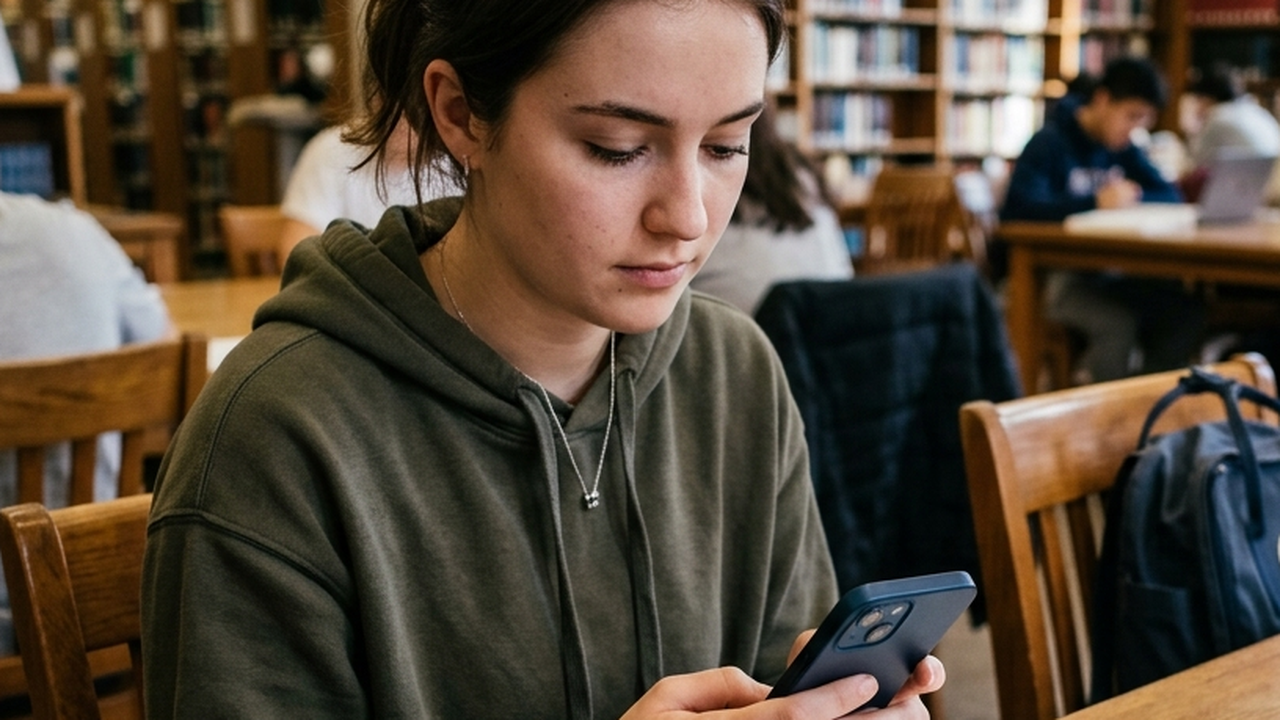
People who procrastinate almost always know what they should be doing. Information is not the problem. Starting is.
And the object that gets in the way of starting is often the same one that holds the task. The deadline sits in the phone’s calendar, the group project pings through the messaging app, the document waiting for edits opens on the very screen where, one swipe away, the feed is waiting.
That is the paradox at the heart of smartphone addiction and procrastination: the device is planner, reminder and nag, and it is also the shortest way out of all three.
Neither role cancels the other.
Twenty-Six Studies, Fifteen Thousand Students
In 2024, Guo Chen of China University of Mining and Technology and Chunwei Lyu of Universiti Sains Malaysia published what they describe as the first meta-analysis dedicated to this relationship among students, in the journal Personality and Individual Differences. The question was easy to ask and hard to settle: when studies measure smartphone addiction and procrastination in the same people, do they point the same way?
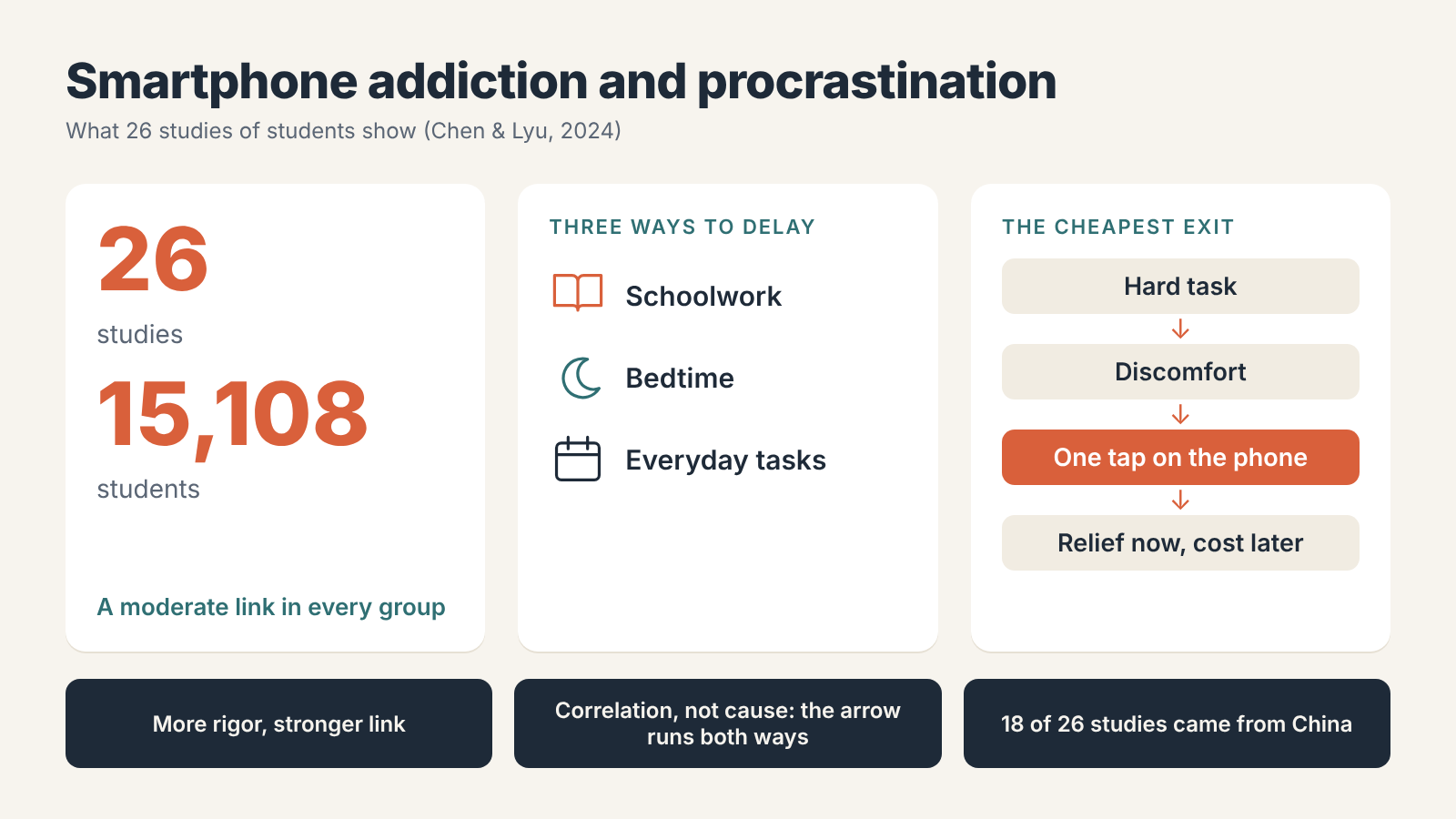
The researchers searched four academic databases plus Google Scholar up to February 2024, started from more than a thousand records, and ended with 26 peer-reviewed studies covering 15,108 participants. Twenty samples were college students; six were middle schoolers.
Across all 26 studies, students who scored higher on smartphone addiction also tended to put things off more. The average link was moderate: too steady to dismiss, too weak to explain on its own why anyone leaves everything for later.
Under the Average
Three Ways to Delay, One Link
The studies measured three kinds of procrastination. Academic procrastination, putting off studying, assignments and revision, showed up in 12 of them. Bedtime procrastination, defined by Kroese and colleagues in 2014 as going to bed later than intended with no external reason to stay up, appeared in seven. General procrastination, the everyday kind that spills into chores and decisions, appeared in another seven.
The link held in all three. It was slightly sharper for schoolwork and bedtime, slightly softer for general delay, but the difference was not large enough to matter in the authors’ analysis. The night that slides through the feed runs on the same logic as the afternoon that slides past the assignment.
Age Was No Shield
Middle schoolers and college students showed roughly the same strength of association. The authors read this as a measure of the device’s pull: if the self-control that grows with age does not weaken the link, the phone’s attraction outweighs maturity.
More Rigor, Stronger Link
This is the most interesting result. In research, effects often shrink as studies get more careful. Here the opposite happened.
The high-quality studies, the ones that identified and controlled for confounders (background variables, such as anxiety or personality, that could create a misleading association), found a stronger link than the medium-quality ones.
Controlling for noise did not erase the relationship. It sharpened it.
The Year Mattered Too
The strength of the association changed with publication year, and the authors point to an intensification between 2019 and 2022. They tie it to the COVID-19 pandemic: remote classes, lockdowns, and the phone turning into classroom, office and town square at once, especially in China, where health measures pushed usage even higher. That is the researchers’ interpretation, not something the study design can test directly. The 26 studies also disagree quite a lot about the size of the effect; the average summarizes a scattered set.
An Exit That Costs One Tap
Why does the phone win the contest with the task? Two ideas help.
The first is compensatory internet use, a model proposed by Daniel Kardefelt-Winther and used by the authors to interpret their result: people turn to the screen to make up for something going wrong offline, whether boredom, loneliness or pressure. The second comes from Fuschia Sirois and Timothy Pychyl (2013), who describe procrastination as a matter of priority: repair your mood now and send the bill to your future self.
Put the two together and the picture gets concrete. A hard task produces a small jolt of discomfort right at the start: the blank page, the problem that won’t come out, the messy spreadsheet. The smartphone offers instant relief at almost zero cost, always in your pocket, always with something new behind the lock screen.
No other exit is that cheap.
So the useful question is not whether the phone is fun. It is whether it has become the fastest way to avoid feeling the first minute of a task. The distinction sounds subtle, yet it changes what helps: someone chasing pleasure needs time limits, while someone escaping discomfort needs to look at what happens right before the tap. Earlier pieces here on short-form videos and prospective memory and on what social media does to attention trace the same pattern from other angles.
Questions for the Second Before You Unlock
Have you ever reached for your phone at the exact moment a task got hard, on the first sentence of the essay or the first problem that wouldn’t work out? That is the short-term mood repair Sirois and Pychyl describe.
Have you ever gone to bed on time and fallen asleep an hour later without ever deciding to? Bedtime procrastination rarely announces itself as a choice.
Have you ever escaped a task using the same device the task was open on?
And the question that matters most: what do you feel in the second before you unlock the screen?
Smartphone Addiction and Procrastination: A Correlation Without an Arrow
All 26 studies are cross-sectional, single snapshots in time. They show that the two travel together, not which one is pulling. The authors accept both directions: compulsive phone use may feed delay, and people who already procrastinate may find in the phone the perfect hiding place. Most likely both happen at once.
Some important differences were left out. Women and men tend to favor different kinds of apps, social on one side and games on the other, and there were not enough studies to separate those profiles. The authors call for longitudinal research that follows the same people over time, and for samples from other parts of the world.
A Note from the Writer: The Country in the Example Is Missing
One line in the paper’s introduction stuck with me more than any chart. To show how serious the problem is, the authors cite Brazil as one of the worst cases in the world, with more than five hours a day on smartphones, according to an industry survey. Then, in the sample, not a single study from South America. Eighteen of the 26 came from China, and the authors themselves note that Africa, North and South America, and Australia and New Zealand are absent.
If you are reading this in the United States, Canada or Australia, that includes you: no study from your region made it in either. My reading is that the example that opens the paper does not fit the sample that closes it, and that calls for caution in both directions. The link could be stronger in places where the phone carries work, banking, school and family through a single messaging app. It could also look different for cultural reasons none of these studies measured. And one methodological choice bothers me: accepting only English-language papers may have filtered out exactly the researchers who study this problem in Portuguese, Spanish or other languages.
What I take from it for myself is more modest. I have stopped treating procrastination as a character flaw and started treating it as a design problem: if the phone wins because it is the cheapest exit, what I can do is make that exit more expensive for the first few minutes. Keeping the device out of reach while writing the first sentence of something difficult. It is not a remedy the study tested. It is a bet consistent with it.
The task still lives on the same device that offers the escape. That is not changing any time soon.
What Chen and Lyu’s meta-analysis shows is that, among students in several countries, those more hooked on their phones also delay more, and that the link holds up when the research gets more rigorous. The smartphone did not invent procrastination. It just put it one tap away.
If the phone is the cheapest exit, what would make the task a little less expensive to start?
Main reference: Chen, G., & Lyu, C. (2024). The relationship between smartphone addiction and procrastination among students: A systematic review and meta-analysis. Personality and Individual Differences, 224, 112652. https://doi.org/10.1016/j.paid.2024.112652.
If this topic resonates with your experience or what you observe around you, there are other articles exploring the psychological mechanisms behind social media use in this space. Explore, question, and share with anyone who needs to read it.
Enjoyed this perspective? Deepen your understanding at Cyberpsychology Blog www.cyberpsychology.online