


Fifteen minutes.
That is the average delay it takes for the brain to return to its resting electrical baseline after a scrolling session loaded with crisis news. The screen has already turned off. Research on attention and social media measures, during this window, an attentional system that has not yet settled back into place.
Recent scientific findings no longer fit into the routine conversation about screen time. The question is no longer merely how many hours. It has become what exactly is being depleted—and how much remains afterward.
Five of these findings recur with sufficient consistency to warrant careful attention.
A Narrow Filter, Not a Camera
There is a common intuition that the mind records whatever unfolds before it like an active camera. Cognitive psychology describes the exact opposite.
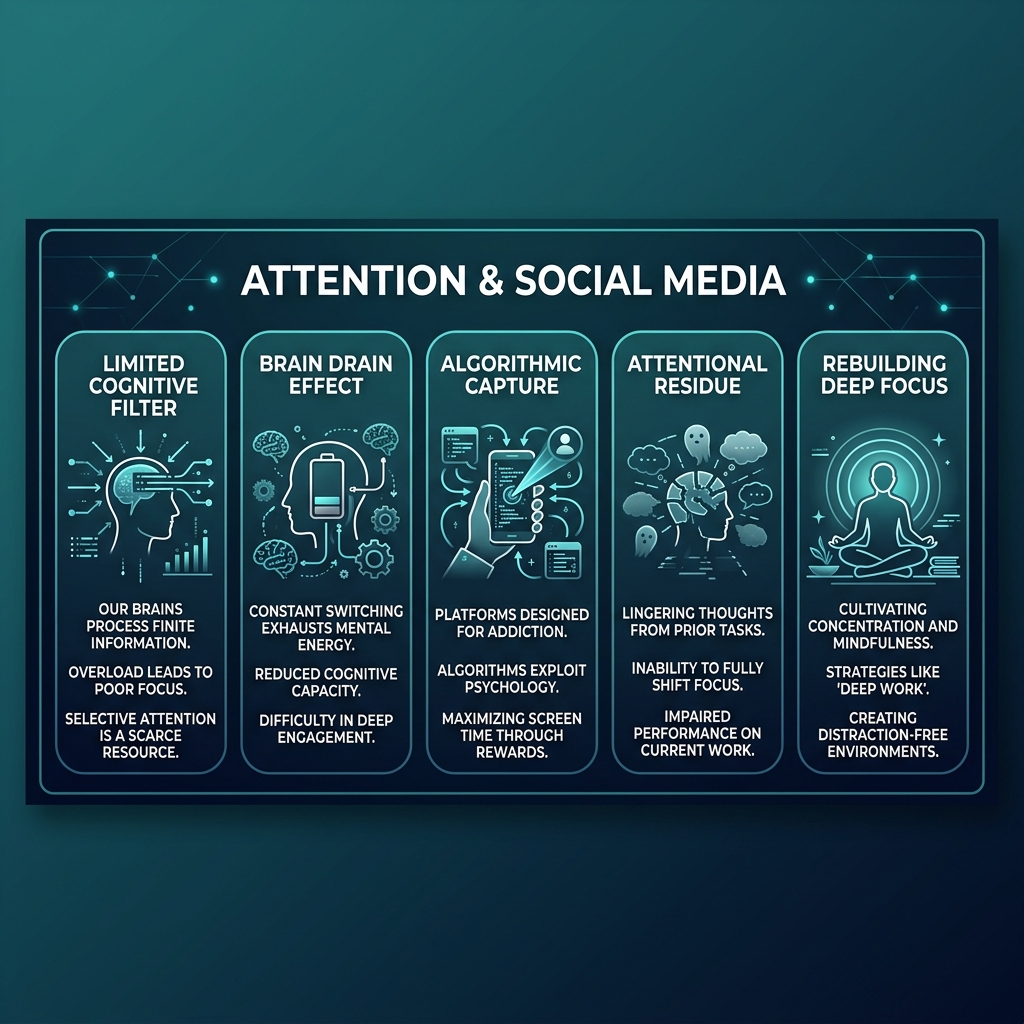
Attention is the mechanism that actively processes a limited amount of information within a massive volume of input from the senses, memory, and cognitive processes. It is a filter, not a recording device. Everything passing through it carries a cost, and the cognitive budget is fixed.
This filter operates under two distinct regimes. Endogenous attention is directed from the inside out by intention and goals—it is what sustains reading a dense contract. Exogenous attention is captured from the outside in by salient stimuli: a sudden noise, peripheral movement, a notification ping.
In 2007, theorist Katherine Hayles introduced a distinction that became central to the debate on attention and social media. On one hand, deep attention: sustained concentration on a single object over extended periods. On the other hand, hyper attention: rapid shifts of focus between tasks and stimuli, characterized by high tolerance for fragmentation and low tolerance for boredom.
Neither regime is inherently superior. The problem arises when one completely vanishes.
The Silent Cost of a Powered-Off Phone
A finding from 2011 remains one of the most uncomfortable in the field. The simple presence of a smartphone on a desk—even powered off and face down—reduces available cognitive capacity.
Literature terms this phenomenon brain drain. A portion of executive system resources remains continuously allocated to inhibiting the impulse to check the device. No one consciously perceives this expenditure, as it does not manifest as active thoughts about the phone. Instead, it manifests as diminished capacity for deep reading, complex problem-solving, and memory consolidation.
A 2025 meta-analysis synthesized 63 studies involving over 124,000 students across 28 countries. The outcome carries an important nuance: smartphone addiction showed a small but consistent association with lower academic performance, and the same held true for video games. However, general social media use itself did not demonstrate a significant direct association with academic grades.
What truly matters, evidence indicates, is not the app itself. It is the compulsive bond with the device—a dynamic that research on smartphone dependency and academic performance has been documenting for years.
Who Decides Where You Direct Your Gaze
Here, the discussion around attention and social media shifts from personal habit to behavioral engineering.
A 2025 study in India combined psychometric scales with in-depth interviews across five public schools in Delhi. Researchers constructed an algorithmic exposure index—a metric quantifying the intensity of content curation rather than overall screen time. This index predicted negative affect and psychological distress even after controlling for total time spent on screens.
Interviews identified two distinct states familiar to most users. The first is the personalization pull: the subjective feeling that recommended content is “too relevant to ignore.” The second is the endless-scroll trance, where temporal awareness dissolves and disengagement becomes remarkably difficult.
A concurrent electroencephalography (EEG) experiment revealed the physiological counterpart. During active feed consumption, the amplitude of alpha waves—associated with attentional rest—drops sharply, while frequency bands linked to arousal spike. The authors’ interpretation was unambiguous: attention was being sustained by platform architecture rather than the intrinsic interest of the observer.
Attention is not merely being divided among many interests. It is being captured by a system engineered specifically to capture it—and capture from the outside in temporarily disables voluntary control.
This same mechanism is analyzed, from another perspective, in research on how algorithms shape adolescent cognition.
Fifteen Minutes After Closing the App
The cognitive cost does not vanish the moment an application is closed.
In the EEG experiment, brain wave activity associated with hyper-arousal and rumination remained elevated long after the session ended. During the final ten minutes of use, signs of accumulated fatigue emerged in the parietal region. Furthermore, crisis content and political feeds delayed the return to baseline resting state by approximately fifteen minutes—an effect far more persistent than that of light content, transforming doomscrolling into a chronic daily drain.
Organizational psychology has long recognized this phenomenon as attentional residue. A fraction of focus remains anchored to the previous task even after switching activities.
A 2023 experiment evaluated the practical consequences. Sixty participants were assigned to TikTok, Twitter, YouTube, or a control group, and subsequently tested on prospective memory—the cognitive ability to remember to execute a planned action in the future. Only the TikTok condition significantly degraded performance. Text feeds and long-form video formats did not produce this impairment.
The proposed mechanism lies in rapid context switching: every 15 to 60 seconds, a new short video introduces a different topic, emotion, and narrative. The intended plan the individual held never receives the quiet window required for memory consolidation.
Attention and Social Media: What Can Be Rebuilt
The optimistic segment of cognitive literature carries a sobering premise. If deep attention can be eroded by environmental design, then it was never an indelible, static trait—it is a cultivated skill, and cultivated skills require deliberate maintenance.
A comprehensive review of digital learning environments outlines strategies with strong empirical support. Brief, regular mindfulness practices serve as direct attentional training. Extended projects unfolding over weeks teach tolerance for deferred gratification. Metacognition—actively observing one’s own attentional state—acts as the foundational pillar supporting these practices.
From a design perspective, neurocognitive researchers offer concrete recommendations: disabling autoplay features and infinite scrolling, and replacing generic “take a break” pop-ups with timers calibrated to real physiological markers of fatigue.
None of these interventions restores focus effortlessly. They simply level the terrain.
Five Questions for Your Own Feed
None of these questions constitute a clinical diagnosis. They are prompts to carry with you.
Have you ever opened an app with a clear intention, only to close it forty minutes later without having accomplished what you set out to do? That is attentional residue working alongside rapid context switching.
Do you keep your phone within sight when tackling demanding work? Research indicates a cognitive cost exists even when the screen is dark.
When was the last time you read thirty consecutive pages of a book without reaching for a digital device? The answer does not define your worth, but it reveals which focus regime is receiving regular exercise.
Do you recognize the sensation that a video was “too relevant to scroll past”? That experience has a scientific name, and it reflects system architecture rather than personal preference.
And the most telling question: after putting down your phone, how long does it take for your mind to truly settle into quiet focus?
Where the Data Remains Tentative
Scientific literature on attention and social media is young, and much of it cannot yet support strong causal claims.
The EEG study observed one hundred adults in thirty-minute laboratory sessions. Adolescents—the demographic often considered most vulnerable—were excluded. The Indian study relied on a localized sample from a single district. The prospective memory experiment involved sixty individuals under controlled conditions far removed from natural daily routines.
Researchers explicitly point to necessary future directions: longitudinal designs and ecological momentary assessments gathered in naturalistic settings rather than laboratories. The central question remains open: whether the recovery of deep attentional capacity is complete or partial after years of intense digital exposure.
The Resource Nobody Returns
Summarized for a friend, the core argument fits into two sentences. Attention is a finite cognitive resource, and the digital ecosystem was engineered by individuals who understood that fact thoroughly. What is at stake is not merely time—it is the autonomy to choose where that time is directed.
Understanding the relationship between attention and social media does not automatically neutralize algorithmic capture. But it renders the mechanism visible, which is an essential first step.
The ultimate question is not how many hours you spend online each day. It is this: if your attention were billed by the minute, which of the last seven days would you ask to have refunded?
Primary references for this synthesis: Satani, A., Satani, K. K., Barodia, P., & Joshi, H. (2025). Modern Day High: The Neurocognitive Impact of Social Media Usage. Cureus, 17(7), e87496. — Chiossi, F., Haliburton, L., Ou, C., Butz, A., & Schmidt, A. (2023). Short-Form Videos Degrade Our Capacity to Retain Intentions. CHI ’23, ACM. — Kuş, M. (2025). A meta-analysis of the impact of technology related factors on students’ academic performance. Frontiers in Psychology, 16, 1524645. — Gupta, U. et al. (2025). Understanding the Impact of Social Media Algorithms on Teenagers’ Brain and Emotions. International Journal of Environmental Sciences, 11(22s), 553–559. — Hayles, N. K. (2007). Hyper and deep attention. Profession, 187–199.
If this topic resonates with your experience or what you observe around you, there are other articles exploring the psychological mechanisms behind social media use in this space. Explore, question, and share with anyone who needs to read it.
Enjoyed this perspective? Deepen your understanding at Cyberpsychology Blog www.cyberpsychology.online