


For nearly a century, “intelligent” was synonymous with a high score on a logic test. A single number was assumed to summarize human potential. While mainstream psychology abandoned this reductionist view decades ago, it survives intact in popular culture—and public debate surrounding digital intelligence and technology often inherits this flaw, asking whether social media makes us dumber as if a single mental meter were sliding up or down.
It is not.
The Collapse of the Single G-Factor
Psychologist Charles Spearman famously proposed a single underlying mental energy, the g-factor, from which all cognitive capabilities were thought to derive. Decades later, Howard Gardner took the opposite path, formulating the theory of Multiple Intelligences—distinct computational competencies that operate relatively independently.
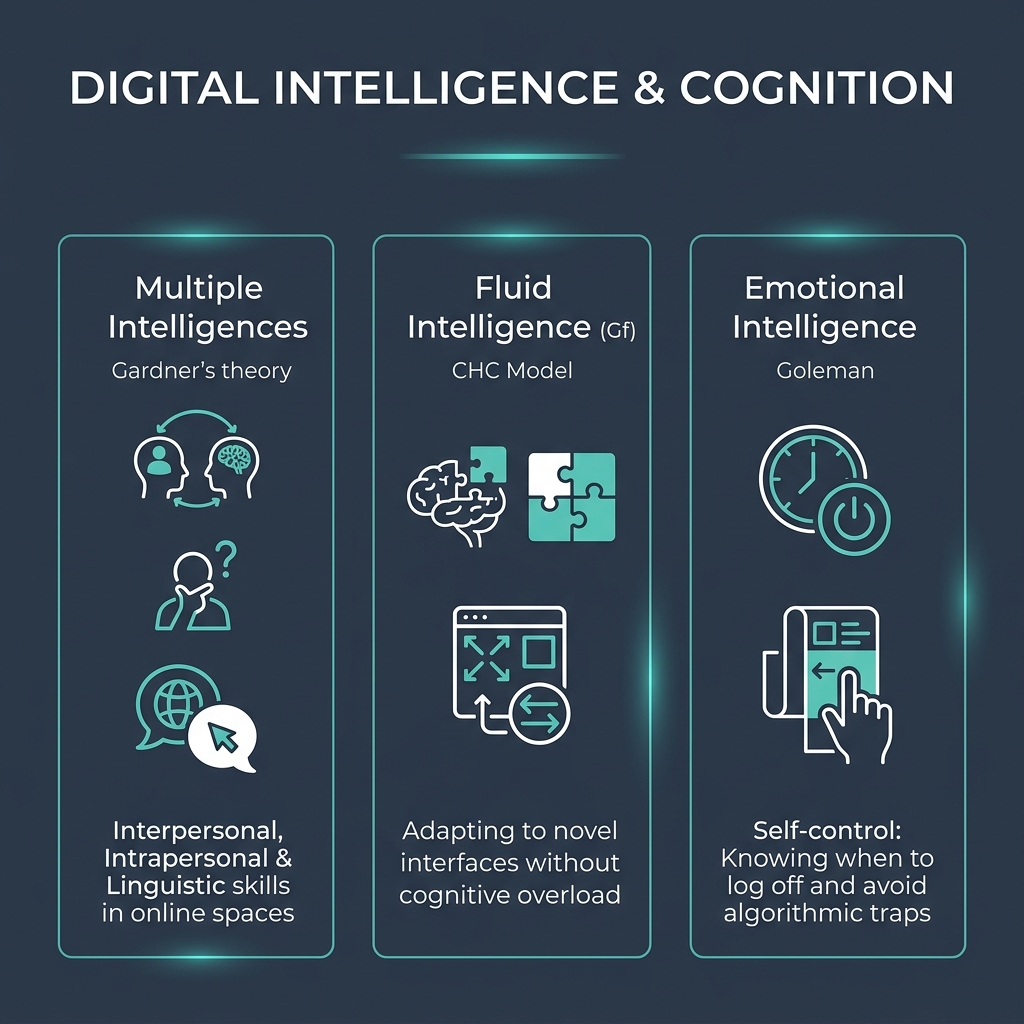
In hyper-connected digital environments, three of Gardner’s intelligence modalities are constantly put to the test:
- Interpersonal Intelligence: The ability to decipher human intentions. In a social feed, this means distinguishing genuine human expression from algorithmic curation designed to hook attention.
- Intrapersonal Intelligence: Self-awareness. Without it, continuous scrolling takes control. Understanding one’s own internal states remains one of the most sophisticated expressions of human intelligence.
- Linguistic Intelligence: Communicating with precision in an environment dominated by short texts, rapid exchanges, and hurried reading.
Fluid Cognitive Capacity Against Algorithmic Noise
The Cattell-Horn-Carroll (CHC) model—widely recognized as one of the most comprehensive frameworks of human cognitive architecture—draws a sharp distinction between crystallized knowledge and Fluid Intelligence (Gf), which is the ability to reason, solve novel problems, and adapt to unfamiliar situations without relying on prior instruction.
The digital ecosystem presents an unmatched volume of novelty. An optimistic perspective suggests that navigating complex interfaces, processing multimedia formats, and rapidly evaluating information streams active exercises fluid reasoning. However, fluid capacity has a cognitive threshold: exceeding it leads to mental fatigue rather than growth. The internet serves simultaneously as a cognitive gym and a source of sensory overload, and the boundary between exercise and exhaustion is thin.
Emotional Self-Regulation: The Goleman Shield
Daniel Goleman popularized Emotional Intelligence—encompassing self-regulation, empathy, and intrinsic motivation—and it is arguably this domain that determines how digital intelligence and technology interact in daily life.
Knowing when to close an application, resisting the urge to join a futile online argument, and refusing to measure self-worth against curated digital profiles are skills that never appear on a standardized IQ test. Yet, these emotional competencies represent the ultimate line of defense separating those who master digital tools from those who are exploited by them.
The Bridge to Personal Reflection
Consider how your mind behaves when you open your smartphone without a specific objective. Do you notice the immediate impulse to fill a silent moment, or do you retain conscious agency over your attention?
When you encounter polarizing content, is your immediate reaction driven by emotional reactivity or by analytical evaluation? Each interaction in the digital realm maps directly onto these fundamental psychological mechanisms.
Adaptation Over Numerical Scores
The American Psychological Association defines intelligence as the global capacity to adapt to the environment. Under this definition, our understanding of digital platforms must shift: social networks neither simply elevate nor depress an internal scorecard. Instead, they alter the environment itself, fundamentally redefining which cognitive facets are demanded every day.
Certain traditional skills—such as memorizing geographic routes, recalling phone numbers, or enduring unmediated boredom—have become less frequently required. Other competencies, particularly cognitive filter control and emotional boundaries, have become essential for psychological survival.
No individual is merely a single number on a test.
Primary Reference: Schneider, W. J., & McGrew, K. S. (2018). The Cattell-Horn-Carroll Theory of Cognitive Abilities. In D. P. Flanagan & E. M. McDonough (Eds.), Contemporary Intellectual Assessment: Theories, Tests, and Issues, 4th ed., pp. 73–163.
If this topic resonates with your experience or what you observe around you, there are other articles exploring the psychological mechanisms behind social media use in this space. Explore, question, and share with anyone who needs to read it.
Enjoyed this perspective? Deepen your understanding at Cyberpsychology Blog www.cyberpsychology.online