


Inside almost every phone sits a tiny motor about the size of a coffee bean. In many models it is a shaft carrying an off-center weight. When it spins, the whole device shakes. In newer phones, a small mass slides back and forth on a spring.
It is a cheap, simple part with no intelligence at all.
And yet it has taught millions of people to feel a buzz that never happened. That is phantom vibration syndrome: your hand goes to your pocket, the screen is dark, no notification arrived. The motor never moved. What vibrated was the expectation.
Whether it happens is not the interesting question. Nearly everyone has felt it. The interesting question is what this glitch says about our relationship with the device, and whether it really deserves the weight of the word “syndrome”.
Nine Out of Ten Pockets Have Lied
The numbers are high enough to change the tone of the conversation.
In 2010, Michael Rothberg and colleagues asked staff at a US teaching hospital whether they had ever felt their pager or phone vibrate for no reason. Of the 169 who answered, 68% said yes. Thirteen percent felt it every day. The study appeared in the BMJ with a curious detail: people who carried the device in a shirt pocket reported more episodes than those who clipped it to their belt.
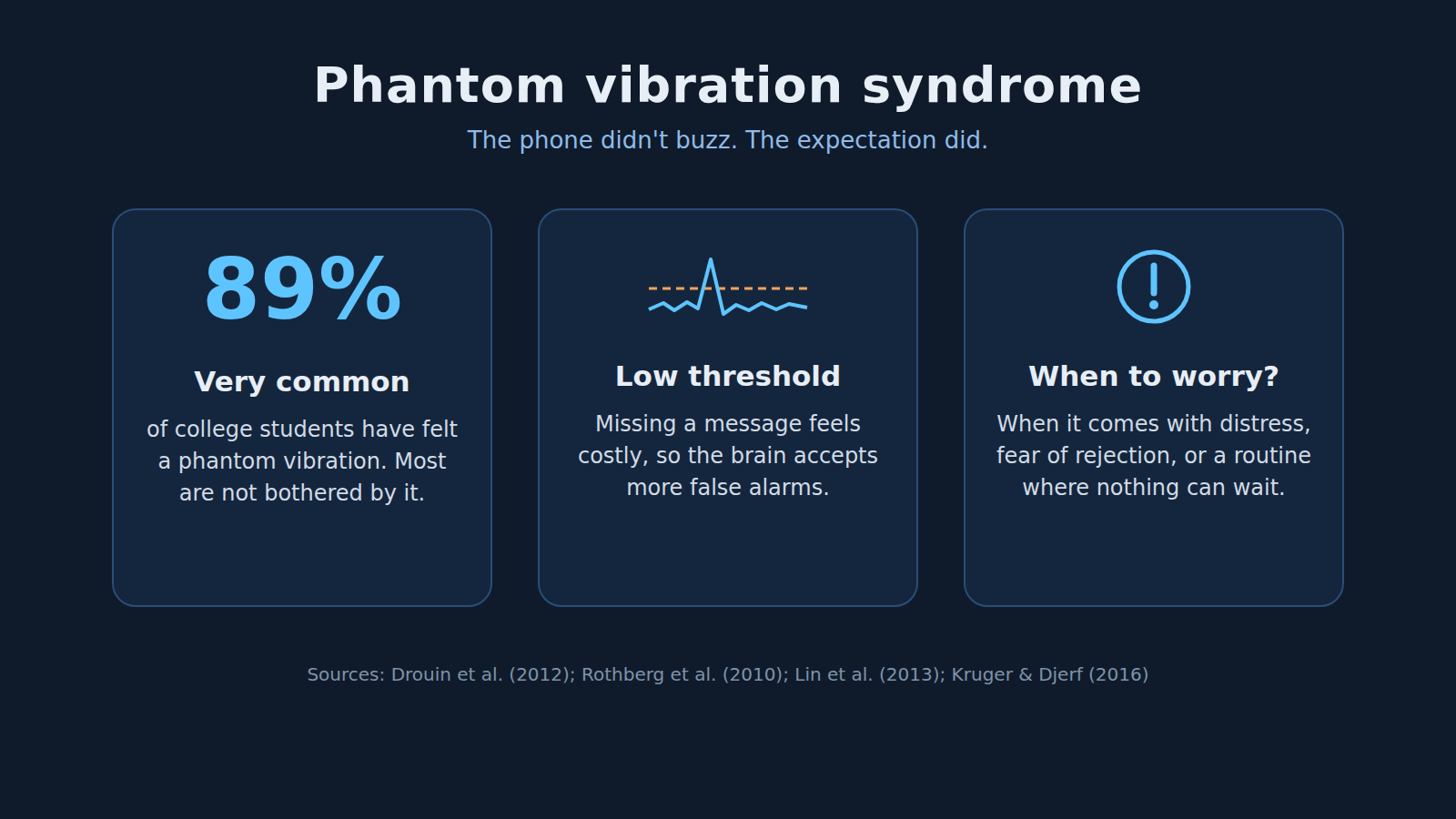
Two years later, Michelle Drouin and her team put the same question to 290 undergraduates. The figure was even higher: 89% reported phantom vibrations, on average about once every two weeks.
But 93% of those students said the sensation bothered them little or not at all.
That is the number that tends to vanish from news coverage. The experience is close to universal and, for the vast majority, trivial.
A Symptom of Addiction, or a Side Effect of Paying Attention?
This is where the interpretations part ways.
The clinical reading
In Brazil, Karlla Souza and Mônica Ximenes Carneiro da Cunha, from the Federal Institute of Alagoas, ran a systematic review of 27 studies on social media and adolescent mental health. Their review places the phantom buzz on a list of signs associated with excessive use, next to insomnia, isolation, oversharing and anxiety about reactions.
In that frame, the imaginary vibration is a marker: the body giving away a vigilance that has gone too far.
The perceptual reading
The studies that actually measured the phenomenon tell a different story. In Taiwan, Yu-Hsuan Lin and colleagues followed 74 medical interns through a year of internship, the most stressful stage of medical training. Before it began, 78% reported phantom vibrations. By the third month, 96% did. Two weeks after the internship ended, the rate had dropped to 50%.
The symptom rose and fell with the workload, not with phone use. Anxiety and depression scores moved too, but the authors found no direct correlation between them and the phantom vibrations.
Drouin also found hints that context and temperament matter. More conscientious people reported fewer episodes. And those who reacted more emotionally to incoming messages were more bothered by the phantoms, without necessarily feeling them more often.
Where the two readings meet
There is a point of contact. In 2016, Daniel Kruger and Jaikob Djerf showed that attachment anxiety, the persistent fear of being rejected or forgotten in relationships, predicts how often people experience phantom ringing. They called it high ringxiety.
In other words, the sensation itself is common and benign. What it carries may not be.
Why the Brain Would Rather Err on the Side of “Yes”
The most widely accepted explanation comes from signal detection theory, a framework developed in the mid-twentieth century for radar operators. The idea is simple. Any system that decides whether a signal has arrived amid noise can fail in two ways: it misses something real (a false negative) or it fires for nothing (a false positive).
You cannot drive both errors to zero at once. Lowering the detection threshold reduces one and inflates the other.
Your thigh is constantly receiving small stimuli: fabric brushing the skin, a muscle twitching, a step that swings the pocket. If missing a message feels costly and checking your pocket feels cheap, the brain lowers the threshold. Any ambiguous tremor now reads as a notification.
Phantom vibration, then, is not a factory defect. It is a setting.
That logic makes sense of the interns in Taiwan. During internship, a missed call can mean a patient left waiting, so the threshold drops. Once the internship is over, the cost of a miss falls and the threshold rises again. The phone’s motor was the same in both periods.
A Note from Brazil: A Threshold Tuned for WhatsApp
Every smoke detector, spam filter and alarm system faces the same choice as those interns. Whoever designs it decides which error is more tolerable. A fire alarm is tuned to go off over burnt toast, because the opposite mistake would cost lives. As someone trained in computer science, I find it hard to look at phantom vibration and not see a detector whose sensitivity has been turned up by its environment.
The brain runs the same calculation, and the environment sets the weights. In Brazil, where I teach, that environment has a name. WhatsApp has become the official channel for almost everything: the class group, the parents’ group, the work roster, the boss’s message after hours, the school’s notice about tomorrow. Missing a message here rarely means missing a like. It can mean missing the rescheduled meeting, the deadline, the note about your child.
None of the prevalence studies above sampled Brazilians, and that is the caveat quick readings leave out. Applying the 89% figure from US undergraduates to a country like this may underestimate the phenomenon rather than exaggerate it. The hypothesis deserves testing: wherever a single messaging app concentrates work, school and family obligations, the collective threshold may be lower than in any sample studied so far. Readers in India, Indonesia, Mexico or South Africa, where WhatsApp plays a similar role, may recognize the pattern.
And then the question changes address. Less “what is wrong with people who feel their phone buzz” and more “what kind of routine was built so that nobody can afford to miss a message”.
The Empty Pocket Test
A few questions help separate the ordinary phantom from the one that is trying to tell you something.
Do you feel the buzz more during exam weeks, deadlines or conflicts than on vacation?
When you realize it was nothing, do you feel relief, or a small sting of disappointment, as if you were waiting for something specific from someone?
Have you ever stayed in a group chat, or refused to mute a contact, out of fear of what you might miss?
None of these answers is a diagnosis. The sensation on its own does not indicate addiction, or any disorder. Content that turns this symptom into a clinical label makes the same move that makes online self-diagnosis so slippery.
The question worth carrying is a different one: if your brain is calibrated never to miss a message, who decided that missing one would be so serious?
Where the Data Still Falls Short
The samples are small and specific: healthcare workers, college students, medical interns. Almost everything relies on self-report, and nobody remembers half-second sensations very well. There is no large longitudinal study with adolescents, precisely the group the Brazilian review most wanted to protect.
We also lack studies that separate the effects of motor type, where the phone is carried and notification patterns. Rothberg’s study points to a practical path. Among participants who tried something, turning off vibration worked for 75%. Moving the phone to another spot worked for 63%. These come from a small sample, but they point toward the environment, not willpower.
That difference matters. Treating the phantom as a moral failing leads to guilt. Treating it as a setting opens room to change the rules that keep the threshold low. Some of those rules are personal; others are collective, as the discussion of golden cages and digital freedom suggests. And the same competition for vigilance shows up in what feeds do to attention and focus.
Turn Off the Motor, Renegotiate the Deal
Phantom vibration syndrome does not prove dependence. It proves that the body has learned, very efficiently, what its environment demands of it.
Most of the time it is harmless. When it comes with distress, fear of rejection or a routine in which nothing can wait, it stops being a curiosity and becomes a message.
The little motor is still sitting motionless in your pocket.
What needs revisiting is the deal that taught you to feel it spin.
Primary reference: Drouin, M., Kaiser, D. H., & Miller, D. A. (2012). Phantom vibrations among undergraduates: Prevalence and associated psychological characteristics. Computers in Human Behavior, 28(4), 1490–1496. https://doi.org/10.1016/j.chb.2012.03.013.
Other sources: Rothberg, M. B. et al. (2010). Phantom vibration syndrome among medical staff: a cross sectional survey. BMJ, 341, c6914. — Lin, Y.-H. et al. (2013). Prevalent hallucinations during medical internships: phantom vibration and ringing syndromes. PLoS ONE, 8(6), e65152. — Kruger, D. J., & Djerf, J. M. (2016). High ringxiety: attachment anxiety predicts experiences of phantom cell phone ringing. Cyberpsychology, Behavior, and Social Networking, 19(1), 56–59. — Souza, K., & Cunha, M. X. C. da (2019). Impactos do uso das redes sociais virtuais na saúde mental dos adolescentes: uma revisão sistemática da literatura (in Portuguese). Educação, Psicologia e Interfaces, 3(3), 204–217.
If this topic resonates with your experience or what you observe around you, there are other articles exploring the psychological mechanisms behind social media use in this space. Explore, question, and share with anyone who needs to read it.
Enjoyed this perspective? Deepen your understanding at Cyberpsychology Blog www.cyberpsychology.online